A practical, science-based water change routine for freshwater tanks. Match change volume and frequency to stocking, feeding, plants, and filtration so your ...
Freshwater aquarium guidance
Aquarium Water Changes: How Often and How Much?
Stop guessing your water change schedule. Learn how often to change aquarium water, how much to replace, and a step-by-step routine that keeps freshwater fish healthy and algae under control.

Written by
Oliver Bennett
Oliver Bennett is a lifelong aquarist with over 15 years of experience in freshwater tank setup, aquascaping, and fish health. Through TankRoot, he shares his passion for creating balanced underwater ecosystems, helping hobbyists of all levels build thriving, beautiful homes for their fish.
Published: October 17, 2026
•
Updated: October 17, 2026
My fishkeeping obsession started with a carnival goldfish that I kept in a bowl, because that is what I was told to do. It went about as well as you would expect. If you have ever felt confused by water change “rules” that contradict each other, you are not alone. The good news is that water changes are not mysterious once you understand what they actually accomplish.
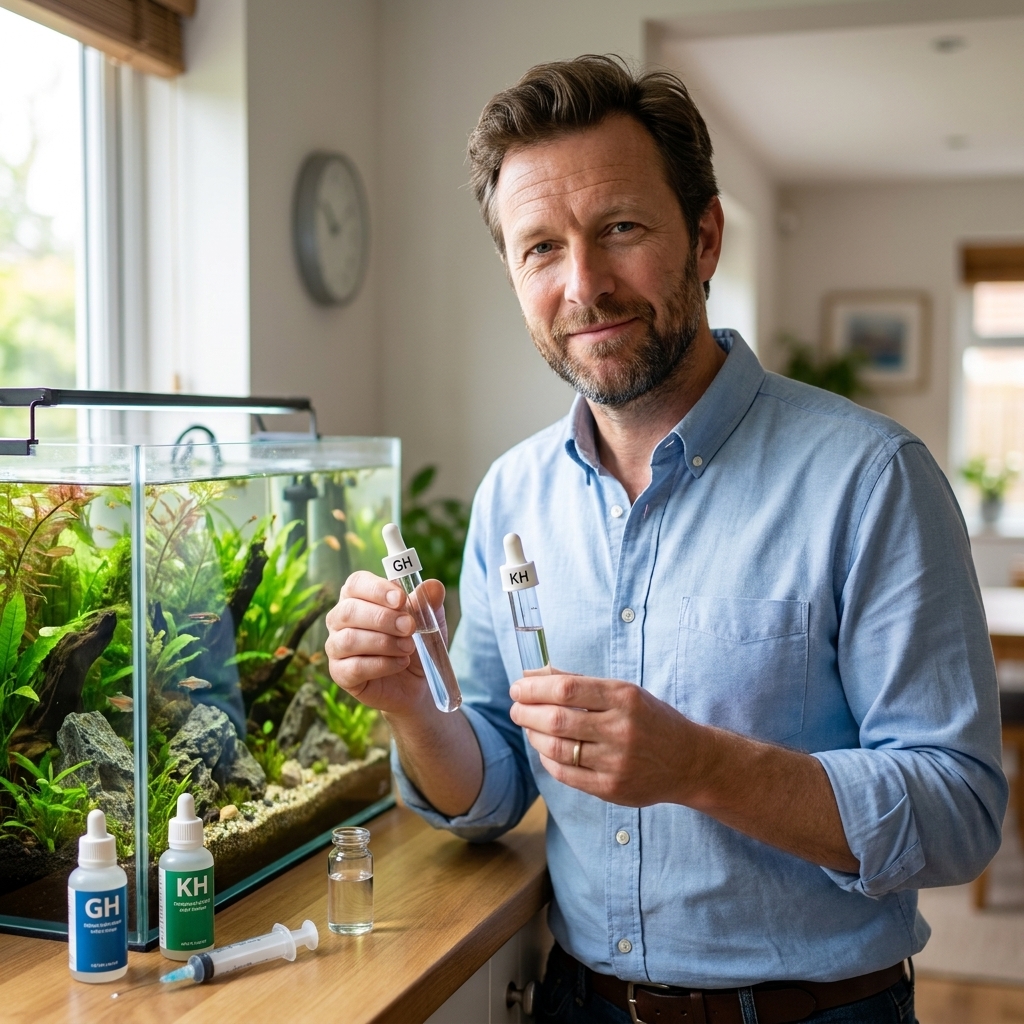
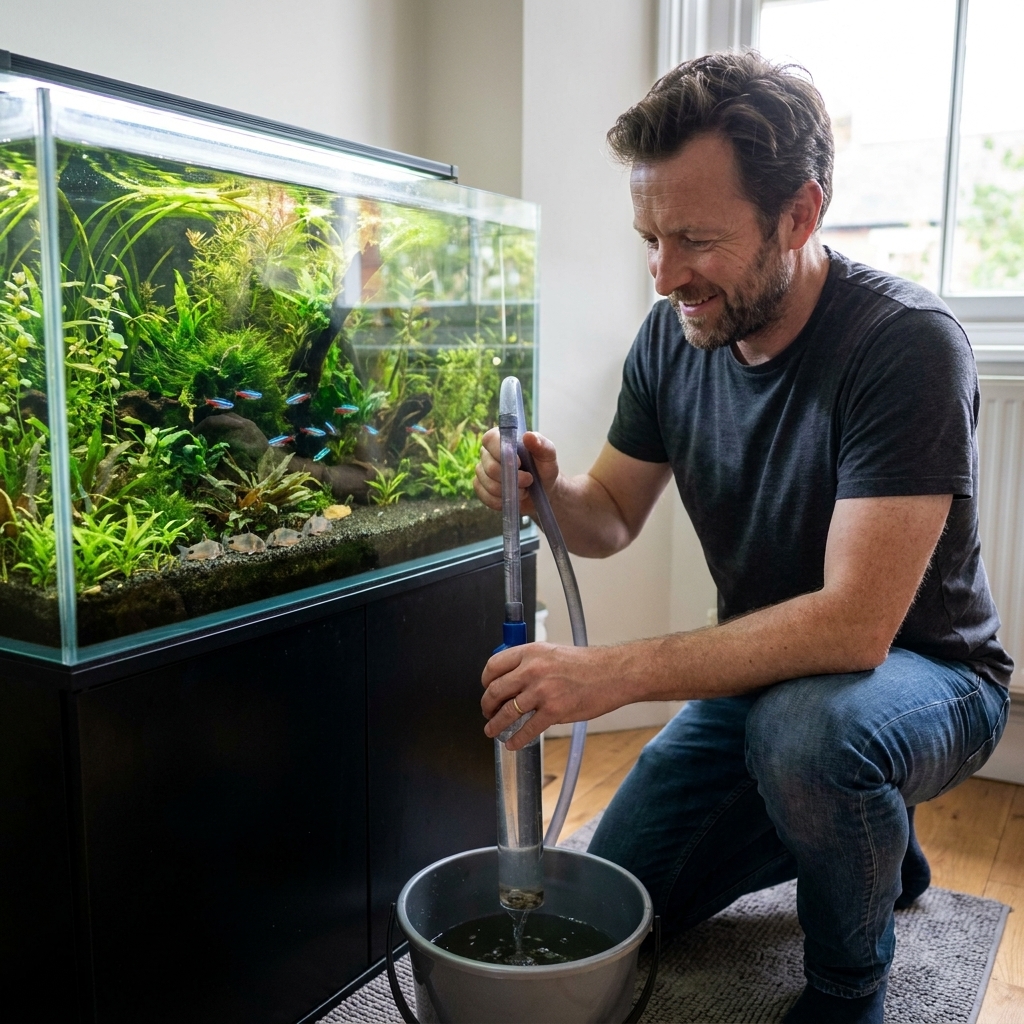
Water changes do three core jobs: they remove dissolved waste (like nitrate and dissolved organic compounds), they reset mineral balance (KH, GH, and trace elements), and they dilute things you cannot easily filter out. Done consistently, they are the simplest, most reliable way to keep fish healthy and plants growing steadily.
What a water change really fixes
Nitrate and dissolved organics
Your beneficial bacteria convert toxic ammonia into nitrite and then into nitrate. Nitrate is far less toxic than ammonia or nitrite, but it is not harmless long-term. Water changes are the most straightforward way to reduce nitrate and other dissolved compounds that build up from food, fish waste, plant decay, and general DOC “old water” accumulation.
Mineral balance (KH, GH) and pH swings
In many tanks, especially community tanks, consistency matters more than chasing a perfect number. Regular water changes help prevent KH from slowly dropping too low, which can increase the risk of pH swings or even a crash in systems where acids build up. They also keep GH and trace minerals in a healthy range for fish, plants, and invertebrates.
Growth-inhibiting compounds and “stale” water
In aquaculture, there is evidence that some fish release compounds (sometimes discussed as hormones or pheromones) that can affect growth and stress in crowded systems. In home aquariums it is harder to generalize, but the practical takeaway still holds: routine water changes dilute a wide mix of hard-to-test “stale water” compounds that can accumulate over time.
How often should you change aquarium water?
The honest answer is: as often as your tank needs to keep ammonia and nitrite at 0 and nitrate in a reasonable range, without constantly stressing fish with big swings. For most freshwater aquariums, that lands in a predictable set of schedules.
Quick schedules for most freshwater tanks
These are solid starting points. Stocking, filtration, feeding, plant mass, and even nitrate in your source water can push you toward more or less.
- Most community tanks (moderate stocking, filtered, cycled): 25 to 35% weekly
- Heavily stocked community tanks: 30 to 50% weekly, sometimes twice per week
- Heavily planted tanks with light stocking: 20 to 30% weekly or every other week (depending on nitrate and algae)
- Breeding and grow-out tanks: 30 to 70% several times per week (yes, really), matched closely for temperature and dechlorinated
- Goldfish tanks: 40 to 60% weekly (or more) due to high waste output
- Small tanks (5 to 10 gallons): 25 to 50% weekly because parameters shift faster
Use nitrate to personalize the schedule
If you want a dial-it-in method, use nitrate as your guide once your tank is cycled.
- Step 1: Test nitrate right before a scheduled water change.
- Step 2: If nitrate is consistently higher than you want, either increase how much you change or how often you change.
- Step 3: Keep adjusting until your pre-change nitrate is steady week to week.
As a general comfort zone for typical freshwater community fish, many hobbyists aim to keep nitrate under 20 to 40 ppm pre-change. Some keepers aim for under 20 ppm, especially with sensitive species, shrimp, and fry. Test kits can be imprecise, so focus on trends and consistency. Meanwhile, any measurable ammonia or nitrite in an established tank is a fix-it-today situation.
How often should you test?
- During cycling: test ammonia and nitrite often (daily or every couple of days), and take action if either rises.
- After cycling: test nitrate weekly or biweekly until your routine is stable, then spot-check or test when something changes (new fish, heavier feeding, algae, odd fish behavior).

How much water should you change?
Think in terms of dilution. A water change does not “remove nitrate from the tank” as much as it reduces concentration by replacing part of the water with cleaner water.
Simple dilution math
If your tank water is at 40 ppm nitrate and your replacement water is near 0 ppm nitrate, a:
- 25% water change: nitrate drops to about 30 ppm
- 50% water change: nitrate drops to about 20 ppm
- 75% water change: nitrate drops to about 10 ppm
If your tap water already contains nitrate, your post-change number will be higher. In that case you may need more plant mass, less feeding, more frequent changes, nitrate-removing media, or a lower-nitrate source water (like RO mixed appropriately) depending on your goals.
This is why tiny water changes can feel pointless in high-waste tanks. If nitrate is climbing fast, you usually need either bigger changes, more frequent changes, or both.
When big water changes are safe
In a well-maintained aquarium with steady parameters, large water changes are generally safe as long as:
- New water is properly dechlorinated
- Temperature is close (aim for a couple degrees; tighter matching is important for sensitive fish and fry)
- pH and hardness are not wildly different
Where people run into trouble is not the size of the change, but the sudden parameter swing. If your tank has been neglected for a long time, a massive change can shock fish because the tank water and tap water have drifted far apart. In that situation, do several medium changes over a few days instead of one huge reset.
Best practice routine
This is the routine I teach new keepers because it is consistent, low-stress, and it prevents the most common mistakes.
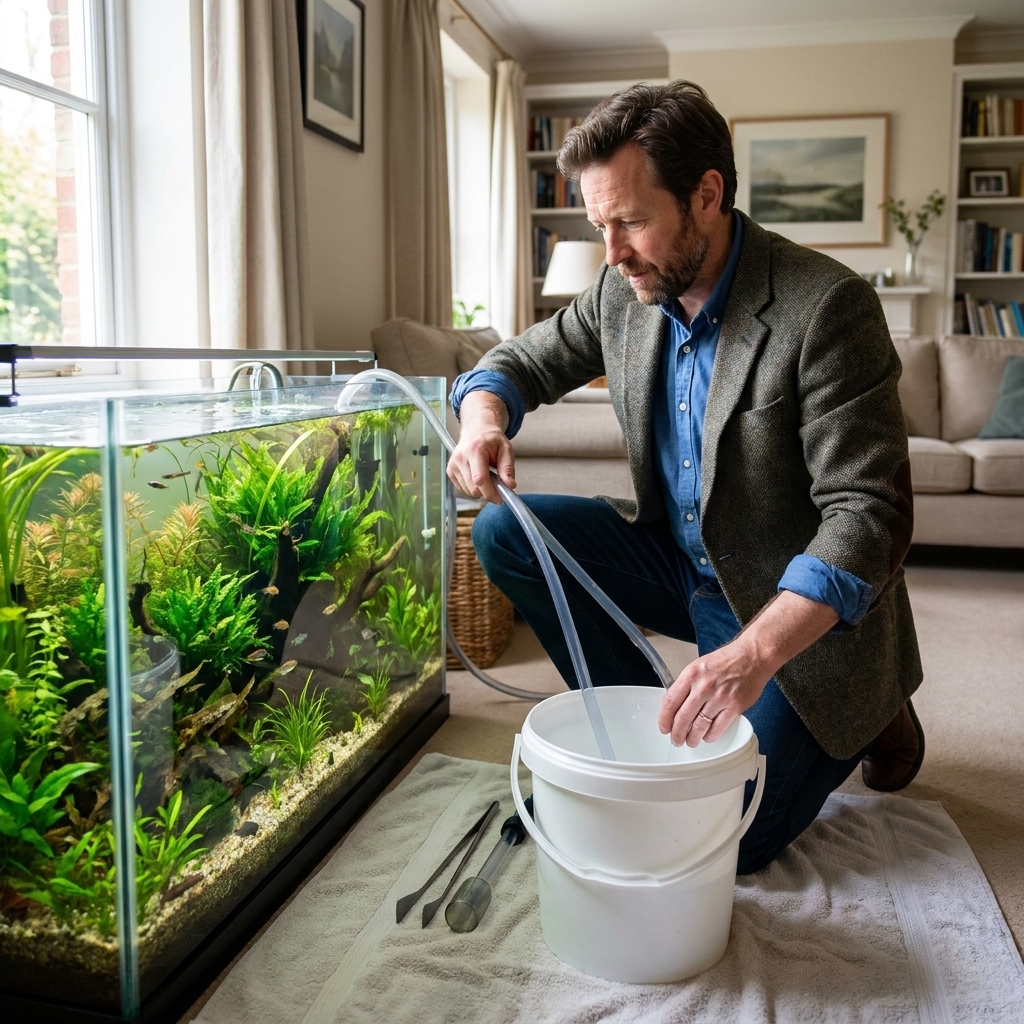
1) Get your equipment ready
- Bucket dedicated to aquarium use only
- Gravel vacuum or siphon
- Water conditioner (dechlorinator)
- Thermometer (optional, but helpful)
- Algae scraper (optional)
2) Turn off heaters and filters
Unplug the heater and filter before draining. Heaters can crack if exposed to air while hot, and some filters can run dry.
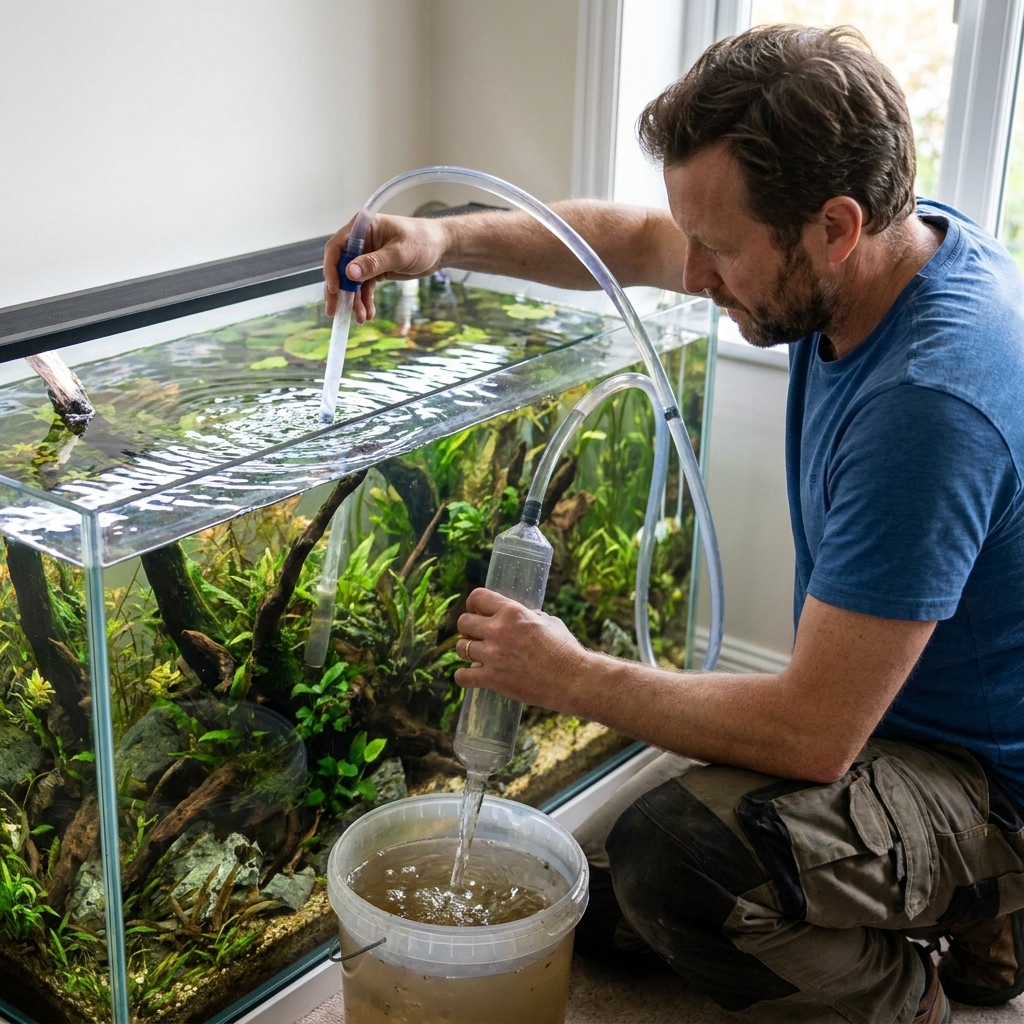
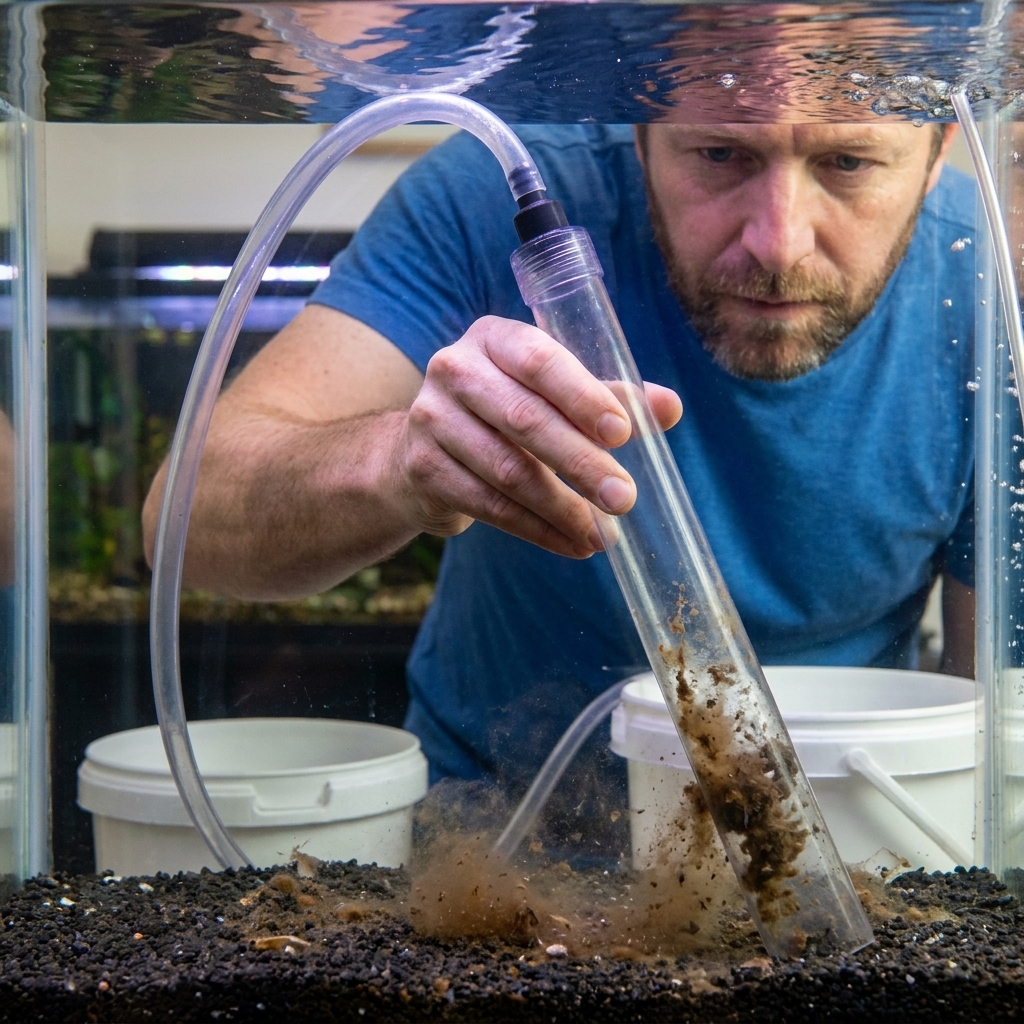
3) Siphon water out and clean the substrate lightly
Use the gravel vacuum to lift debris out of the substrate. In planted tanks, be gentle around roots. You are not trying to sterilize the gravel, just remove accumulated mulm and uneaten food.
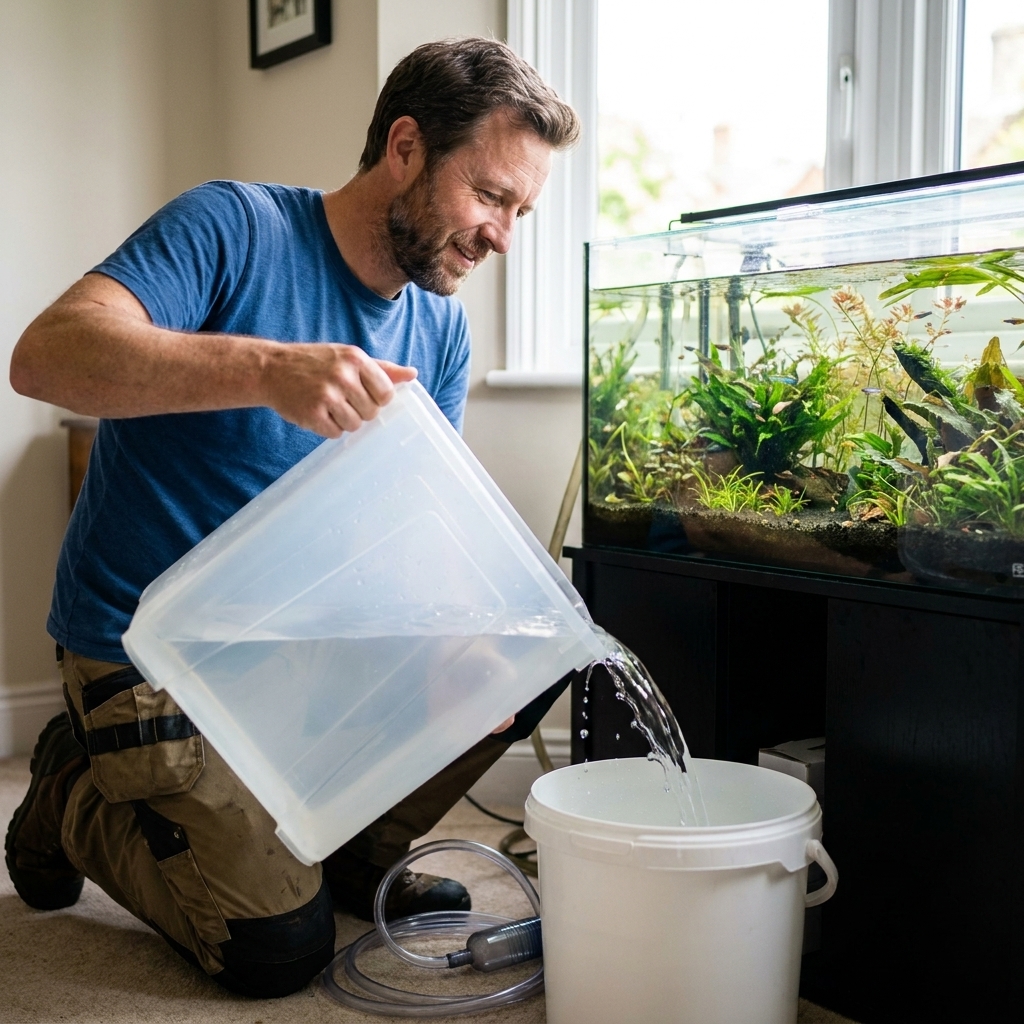
4) Prep replacement water correctly
Match temperature as closely as you reasonably can. Then add dechlorinator to the new water (or dose for the full tank volume if you are filling directly from a tap into the aquarium, following the conditioner’s instructions).
One quick note: many water supplies use chloramine, not just chlorine. A good conditioner will handle both, often by binding the chlorine and temporarily detoxifying the ammonia released from chloramine. Follow label dosing, especially for higher chloramine levels.
5) Refill slowly
Pour onto a plate, bowl, or your hand to avoid blasting substrate and uprooting plants.
6) Restart equipment
Plug the filter back in and confirm flow. Plug the heater back in once it is submerged again.
How to set a schedule for your tank
If you want a schedule that fits your aquarium like a glove, use this quick decision process.
Step A: Identify your waste profile
- High waste: goldfish, large cichlids, messy eaters, heavy feeding, lots of fish per gallon
- Medium waste: most community tanks
- Lower waste: lightly stocked tanks with lots of healthy plant growth
Step B: Watch these signals
- Nitrate rising quickly: you need larger or more frequent changes
- Visible detritus buildup: improve siphoning technique and consider increasing frequency
- Algae blooms: often linked to excess nutrients plus light imbalance, but water changes help reset nutrients and remove organics
- Fish acting “off” before change day: treat that as a hint the schedule is too stretched
Step C: Choose the simplest plan you will actually keep
A perfect schedule you cannot stick with loses to a good schedule you can do every week. Consistency is what gives your aquarium that calm, steady feel where fish color up, plants pearl, and algae stays manageable.
Special cases
Heavily planted aquariums
Plants consume nitrate and other nutrients, so nitrate may stay low even when other dissolved organics are accumulating. That can trick you into skipping water changes for too long. Even in lush planted tanks, I usually recommend some routine change, often 20 to 30% weekly, unless you have a very stable, lightly stocked system and you are watching parameters closely.
Also remember that water changes reset fertilizer levels. If you are dosing a planted tank, your routine may need to account for the “reset” after change day (especially with all-in-one fertilizers or nitrate and phosphate dosing).
Shrimp tanks
Shrimp can be sensitive to swings in temperature, pH, and TDS. Smaller, more frequent water changes are often safer than occasional big ones. Think 10 to 20% weekly, with closely matched water. If you are remineralizing RO water, measure and mix consistently.
Discus and other high-demand fish
For fish that thrive on pristine water, frequent larger changes are normal husbandry, not overkill. The trick is consistency and careful temperature matching.
Common water change mistakes
- Mistake: Replacing filter media during a water change.
Do instead: Rinse sponges or media gently in old tank water, and avoid replacing all biological media at once. - Mistake: Cleaning filter media under untreated tap water.
Do instead: If you need to rinse, use removed tank water in a bucket. Untreated tap water can harm beneficial bacteria (especially if it contains chlorine or chloramine). - Mistake: Deep-cleaning everything on the same day.
Do instead: Stagger big maintenance tasks so your tank biology is not disrupted all at once. - Mistake: Skipping dechlorinator.
Do instead: Always treat new water for chlorine and chloramine. - Mistake: Doing one huge change after months of neglect.
Do instead: Do multiple medium changes over several days to reduce shock. - Mistake: Chasing pH with chemicals.
Do instead: Focus on consistent KH and a steady water change routine. If your tap water is very different from your target, consider RO mixing or keeping fish suited to your natural parameters.
Water change FAQ
Do I need to remove my fish during a water change?
No. In almost all cases, leave fish in the tank. Removing them usually causes more stress and risk than the water change itself.
Should I clean the gravel every time?
In most community tanks, yes, lightly. In heavily planted tanks, vacuum less aggressively and focus on open areas where debris collects.
Is it okay to change 50% of the water every week?
Often, yes, especially for goldfish, messy eaters, and heavily stocked aquariums. Dechlorinate properly and aim for similar temperature to avoid stress.
My nitrate is always 0. Can I stop doing water changes?
Not automatically. Low nitrate can happen in planted tanks, but dissolved organics and mineral drift still occur. Many “mystery problems” in planted tanks improve when you return to steady, moderate water changes.
What if I missed a week?
Do a normal water change as soon as you can. If you missed several weeks and the tank looks and smells old, do a couple of medium changes (for example 25 to 35% every day or two) rather than one extreme swing.
A simple weekly routine
If you want one default plan that works for a huge range of freshwater setups, start here:
- Weekly: 25 to 35% water change
- Weekly: light substrate vacuum in open areas
- Monthly: rinse filter sponge or pre-filter in old tank water
- As needed: scrape algae and trim plants
Then adjust based on stocking, feeding, plants, and nitrate trends. Water changes are not a punishment for having a tank. They are the reset button that lets your aquarium stay a healthy, balanced little ecosystem for years.