A beginner-friendly, step-by-step guide to setting up a 20-gallon freshwater aquarium, from choosing a safe spot and installing gear to cycling the tank and ...
Freshwater aquarium guidance
Choosing the Right Aquarium Heater
Learn how to size an aquarium heater, choose a reliable model, and place it for even heat and safer temperature control. Includes wattage ranges, setup steps, and controller tips.

Written by
Oliver Bennett
Oliver Bennett is a lifelong aquarist with over 15 years of experience in freshwater tank setup, aquascaping, and fish health. Through TankRoot, he shares his passion for creating balanced underwater ecosystems, helping hobbyists of all levels build thriving, beautiful homes for their fish.
Published: October 17, 2026
•
Updated: October 17, 2026
I still remember my first “real” heater. I bought whatever the pet store employee handed me, stuck it in the tank, and trusted the dial. The water swung several degrees overnight and my fish paid for my shortcut.
A heater is not glamorous gear, but it is life support for most tropical freshwater setups. When you choose the right size, the right style, and place it correctly, you get something priceless: stable temperature. Stable temperature means less stress, fewer disease outbreaks, better appetites, and more predictable breeding behavior.
Step 1: Pick your temps
Before you calculate watts, you need two numbers:
- Target water temperature: Most community tropical tanks thrive around 76 to 78 °F (24 to 26 °C). Some fish want warmer (discus), some cooler (many hillstream species), and some do best unheated (many temperate setups).
- Coldest room temperature: Use the temperature your home reaches at night in winter, not your daytime thermostat setting.
The bigger the gap between room temperature and target temperature, the harder your heater has to work. That is also when lids, drafts, airflow, and tank shape start to matter a lot.
Step 2: Estimate real volume
“Tank size” on the box is a starting point, not gospel. A 20 gallon aquarium with thick substrate, big rocks, and wood might hold noticeably less water than 20 gallons.
If you want a more realistic volume:
- Use the tank’s inside dimensions (length × width × water height), not the rim-to-rim measurements.
- Subtract a little for hardscape and substrate if your tank is heavily filled.
- When in doubt, size for the actual water volume and then verify performance with a thermometer.
Step 3: Size heater wattage
There are detailed formulas, but hobbyists do best with a rule of thumb that accounts for real life heat loss. Start with tank volume and the temperature difference between your room and your target.
Conservative wattage rules
These ranges lean conservative for typical covered freshwater tanks, especially if your room is drafty, the tank sits on an outside wall, or you run cooler indoor temps in winter. If your home is warm and stable, you can often land toward the low end.
- Small difference (5 °F or less): 2 to 3 W per gallon
- Moderate difference (6 to 10 °F): 3 to 5 W per gallon
- Large difference (11 to 15 °F): 5 to 7 W per gallon
If you prefer metric: roughly 0.5 to 1.9 W per liter, depending on the temperature gap and heat loss.
Quick examples
- 20 gallon tank, room drops to 72 °F, target 78 °F (6 °F difference): aim for 60 to 100 W.
- 55 gallon tank, room drops to 68 °F, target 78 °F (10 °F difference): aim for 165 to 275 W, ideally split into two heaters.
My default recommendation for most tropical homes: pick a heater (or two) that lands in the middle of the range, not the maximum. Oversizing can create hotter local zones and faster temperature spikes if something fails.
One heater or two?
If your tank is over about 30 gallons, or your room gets chilly in winter, two heaters are often the safer path.
Why two helps
- Redundancy: If one heater fails off, the other slows the temperature drop.
- Less catastrophic overheating risk: If one heater fails on, a smaller heater has a harder time cooking the tank quickly.
- More even heat distribution: You can place them to reduce cold corners.
A common approach is to split your total wattage roughly in half. For a 55 gallon tank needing around 200 W total, use two 100 W heaters.
That said, the biggest safety multiplier is usually an external temperature controller, whether you run one heater or two.
Heater styles
There are three main heater styles you will see for freshwater aquariums. Each can work, but some are more forgiving than others.
1) Glass submersible heaters
Pros: Affordable, widely available, accurate when paired with a reliable thermostat, easy to replace.
Cons: Glass can crack if exposed to air while hot, hit by rock hardscape, or handled roughly during water changes.
Best for: Most planted community tanks, especially when protected by placement and good habits.
2) Shatter-resistant submersible heaters
Pros: More impact-resistant, a good choice for tanks with large cichlids, turtles, or clumsy maintenance routines.
Cons: Quality varies a lot by brand. Some cheaper units drift over time.
Best for: High-risk tanks where glass breakage is a realistic concern.
Extra tip: Consider a heater guard if you keep fish that slam into equipment, rest on heaters, or if you are trying to prevent burns and breakage.
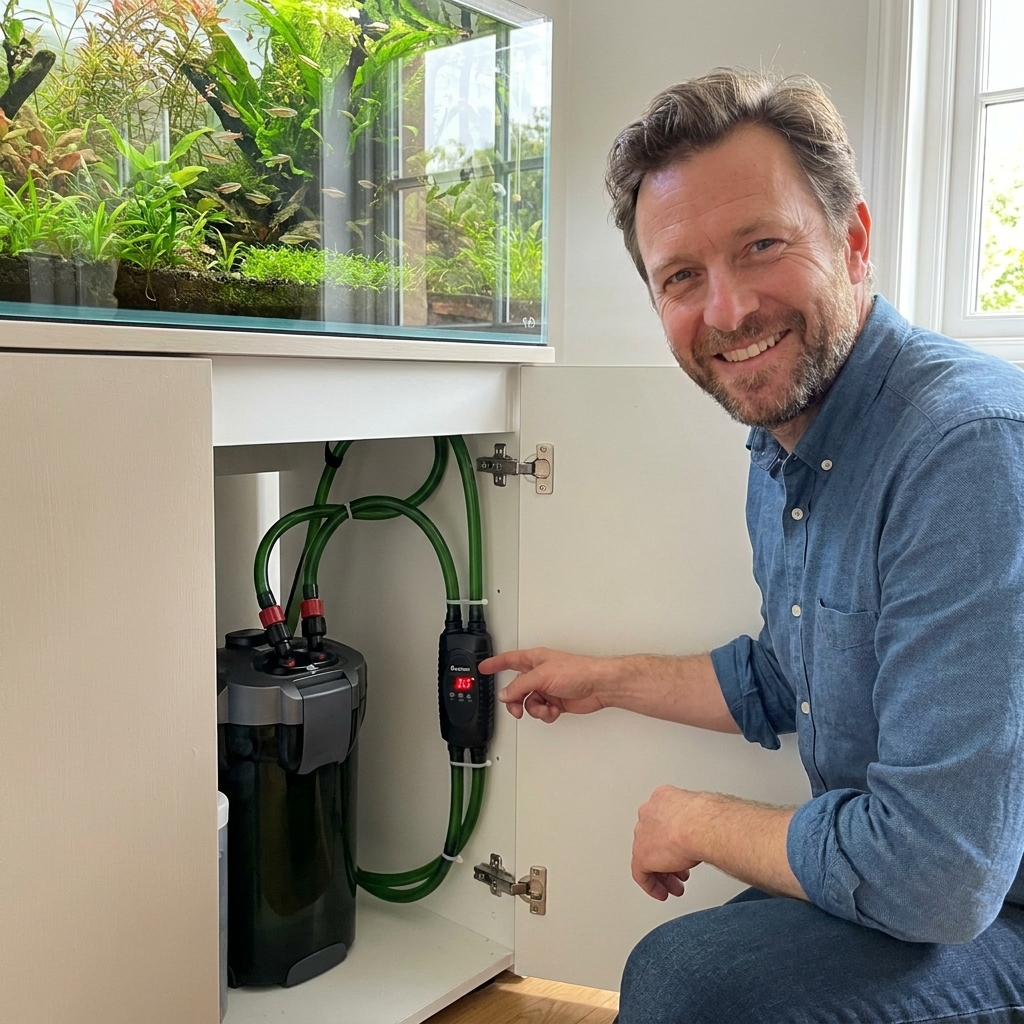
3) Inline heaters
Pros: Clean look inside the tank, excellent heat distribution because warmed water is pushed throughout the aquarium.
Cons: More expensive, requires compatible hose sizes and careful leak prevention, not ideal for beginner setups.
Best for: Canister-filter tanks where you want maximum aesthetics and even temperature.
Brands and build quality
I avoid pretending there is a single “best” heater forever. Manufacturing batches change. What matters is design, consistency, and how you use the heater.
What to pay for
- Good calibration and low drift: Heaters that hold a steady set point without slowly creeping warmer or cooler.
- Clear wattage and submersion markings: You should not have to guess how deep it can go.
- Strong safety features: Overheat protection, thermal fuses, and reliable seals at the cord entry point.
- Replaceable approach: I would rather buy a reasonably priced heater I can replace every few years than gamble on a mystery unit.
My practical shortlist
- Eheim Jager: A long-time favorite in the hobby for consistency and durability when used correctly.
- Fluval (submersible options): Solid mainstream choice, widely available, generally dependable.
- Finnex (titanium style options): Popular for tough builds and higher-risk tanks, especially when paired with an external controller.
Important note: even a “good” heater can fail. The real upgrade is adding a separate temperature controller (more on that below).
Best upgrade: a controller
If you have ever experienced a heater sticking on, you understand why seasoned aquarists treat controllers like cheap insurance.
An external controller uses its own temperature probe and cuts power to the heater if the water rises above your set limit. This prevents many overheating disasters, even if the heater’s internal thermostat fails.
- Set the heater slightly above your target temperature if the controller manufacturer recommends that method.
- Set the controller to your true target temperature (and configure the heating differential if available).
- Place the probe where it reads representative tank water, not right beside the heater.
For fish health, this is one of the highest value pieces of gear you can add to a heated aquarium.
Placement for even heat
Heaters do not “heat the tank.” They heat the water passing around them. Your filter and water movement do the real distribution work.
Placement rules
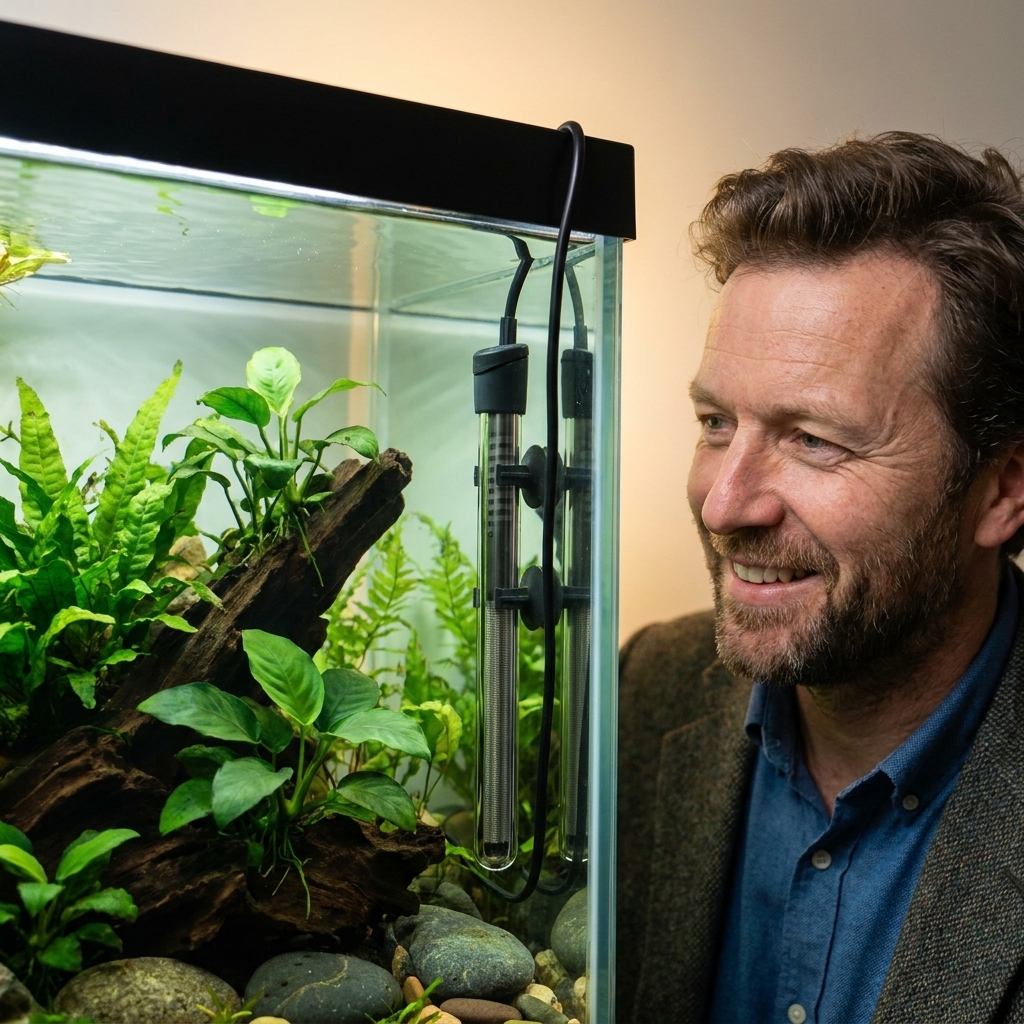
- Place it near flow: Put the heater close to the filter outflow or in an area with consistent circulation so warmed water spreads quickly.
- Avoid dead zones: Corners with little movement can stay cooler, especially in long tanks.
- Keep it fully submerged if the heater is rated fully submersible. Follow the minimum water line markings.
- Do not bury it: Never place a heater under substrate. It can overheat and crack or melt parts.
Vertical or horizontal?
Either can work if the heater allows it. I often prefer a slight horizontal angle low in the tank. That helps when water level drops a little during evaporation, and it tends to reduce extreme hot spots.
If you use two heaters, place them at opposite ends or one near the intake and one near the outflow, depending on your layout and scape.

Safe installation
1) Rinse and inspect
Rinse the heater body with clean water. Check for cracks (glass heaters), damaged cords, or loose suction cups.
2) Mount it securely
Attach suction cups to clean glass. Make sure the heater is not pressed hard against hardscape where it could be knocked or pinched.
3) Let it acclimate
If the heater has been sitting in a cold room or delivered in winter, place it in the tank unplugged for 15 to 30 minutes so the glass and internal components can adjust to water temperature.
4) Make a drip loop
Always run the cord so it dips below the outlet before rising back up. That way, water cannot travel along the cord into the socket.
5) Use GFCI protection
If you can, run aquarium equipment on a GFCI outlet (or a GFCI adapter). It is one of the simplest upgrades you can make for electrical safety around water.
6) Power on and verify
Never trust the heater dial alone. Use a reliable aquarium thermometer and check temperature morning and night for the first few days.
7) During water changes
If there is any chance the heater could be exposed to air as the water level drops, unplug it. After refilling, wait 10 to 15 minutes before turning it back on. This helps prevent thermal shock to the heater, especially glass models.
Dial it in gently
If your tank is far from the target temperature, raise it slowly.
- Typical safe pace: about 1 to 2 °F per day for many community fish.
- Use extra caution: sensitive species, shrimp, and already-stressed fish may need slower changes.
- Watch behavior: rapid breathing, lethargy, and frantic swimming are signs you should slow down and double-check oxygenation and temperature accuracy.
Warmer water holds less oxygen, so increased surface agitation can be helpful when you bump temperatures up.
Troubleshooting
“My heater light is on, but the tank is cold”
- Check that the heater is actually rated for your tank volume and temperature difference.
- Confirm the thermometer is accurate. Cheap stick-on strips can be off by several degrees.
- Make sure the heater is near flow and not trapped behind decor.
- Verify the room is not dropping colder than you assumed.
“The heater shuts off, but the temperature keeps rising”
- Unplug the heater immediately and confirm temperature with a second thermometer.
- Consider a stuck thermostat. Replace the heater.
- Check for nearby heat sources: direct sun, a hot filter motor in a tight cabinet, or strong room heating vents.
“My temperature swings day and night”
- Improve circulation. Temperature stratification is common in taller tanks with weak flow.
- Add a lid or cover to reduce heat loss from evaporation.
- Use two heaters or a controller for tighter regulation.
“My heater keeps dropping”
- Clean the glass where the cups attach. Biofilm and algae weaken grip.
- Replace old suction cups. They harden over time.
- Consider a heater guard or bracket if livestock constantly bumps it.
Special cases
Shrimp tanks
Many shrimp are sensitive to rapid swings. Stability matters more than chasing a perfect number. If you keep Caridina varieties that prefer cooler water, you might not need a heater at all depending on your home. If you do heat, use a controller and keep changes gentle.
Betta tanks
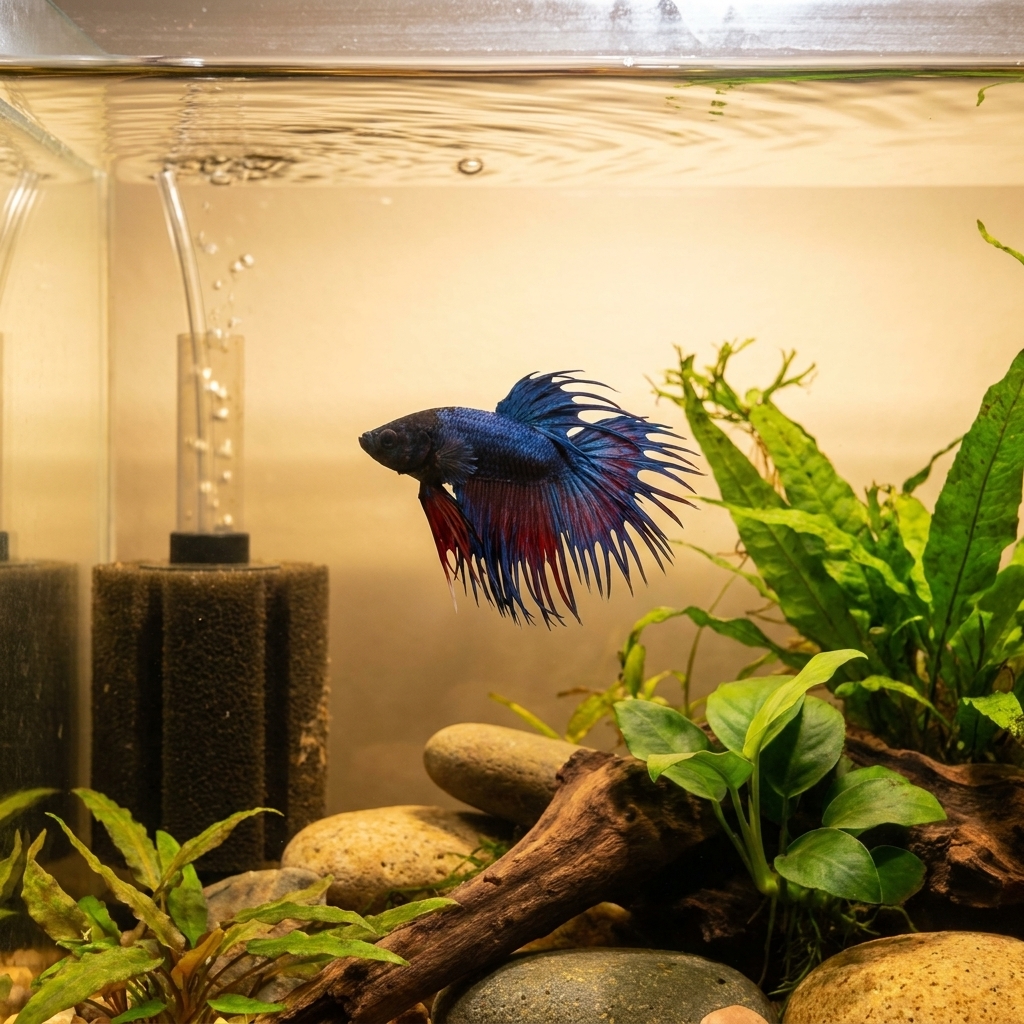
Bettas do best warm and stable, typically 78 to 80 °F. Small tanks lose heat faster, so pick a heater designed for nano volumes and verify it does not overshoot. For 5 to 10 gallons, avoid “too big for the tank” heaters that can create quick spikes.
Planted aquascapes
CO2 injection and dense planting do not change heater sizing much, but they do make you care about aesthetics and consistency. Inline heaters or hiding a submersible heater near the filter return can keep the scape clean while maintaining even heat.
Calibrate and recheck
Even good heaters can be a little off. After the tank has been stable for a day or two, compare:
- What the heater dial says
- What your thermometer actually reads
If your model supports calibration, adjust it according to the manufacturer’s instructions. If it does not, just remember the offset and set the dial accordingly, or let an external controller do the precision work.
Buy checklist
- Know your actual water volume and coldest room temp.
- Choose a wattage based on the real temperature gap and your heat loss (lid, drafts, airflow).
- Decide whether you should run two smaller heaters.
- Pick a heater style that matches your livestock and layout, and consider a heater guard for rough tanks.
- Plan placement near consistent water flow.
- Buy or budget for a separate thermometer and ideally an external controller.
- Use GFCI protection and a proper drip loop.
FAQ
Can I mix an adjustable heater and a preset heater?
You can, but mixing heater types often creates confusion when troubleshooting. If you run two heaters, I prefer two adjustable units of the same model, or one adjustable heater controlled by an external temperature controller.
Is it okay if my heater touches the glass?
Light contact is usually fine, but I avoid pinning a heater tightly against glass or hardscape. You want water to flow around it so heat disperses evenly.
How often should I replace an aquarium heater?
If it is working perfectly, you do not need to replace it on a strict schedule. That said, many aquarists replace heaters proactively every few years, especially on valuable or sensitive livestock. At minimum, inspect cords, seals, and temperature accuracy regularly.
What is the most accurate way to check water temperature?
A quality digital thermometer with a probe is usually easiest to read and consistent. I still like to verify once in a while with a second thermometer, especially if fish behavior suggests something is off.
If you want the calm, meditative version of fishkeeping, temperature stability is one of the foundations. Get the wattage right, put the heater where flow can do its job, and verify everything with a separate thermometer. Your fish will act like different animals when the environment stops swinging under them.