A calm, actionable emergency plan to detoxify ammonia fast, keep fish breathing, and fix the root cause so the spike does not return.
Freshwater aquarium guidance
Cloudy Aquarium Water: 5 Common Causes and How to Clear It Up
Cloudy tank water is usually a bacterial bloom, algae, or dusty substrate. Learn how to identify the cause and fix it safely without harming fish or crashing your cycle.

Written by
Oliver Bennett
Oliver Bennett is a lifelong aquarist with over 15 years of experience in freshwater tank setup, aquascaping, and fish health. Through TankRoot, he shares his passion for creating balanced underwater ecosystems, helping hobbyists of all levels build thriving, beautiful homes for their fish.
Published: October 17, 2026
•
Updated: October 17, 2026
Cloudy aquarium water has a special talent for showing up right when you finally feel like your tank is “dialed in.” I have been there, staring at a milky haze and wondering what I did wrong. The good news is that cloudy water is usually a predictable, fixable problem once you identify what kind of cloudy you are dealing with.
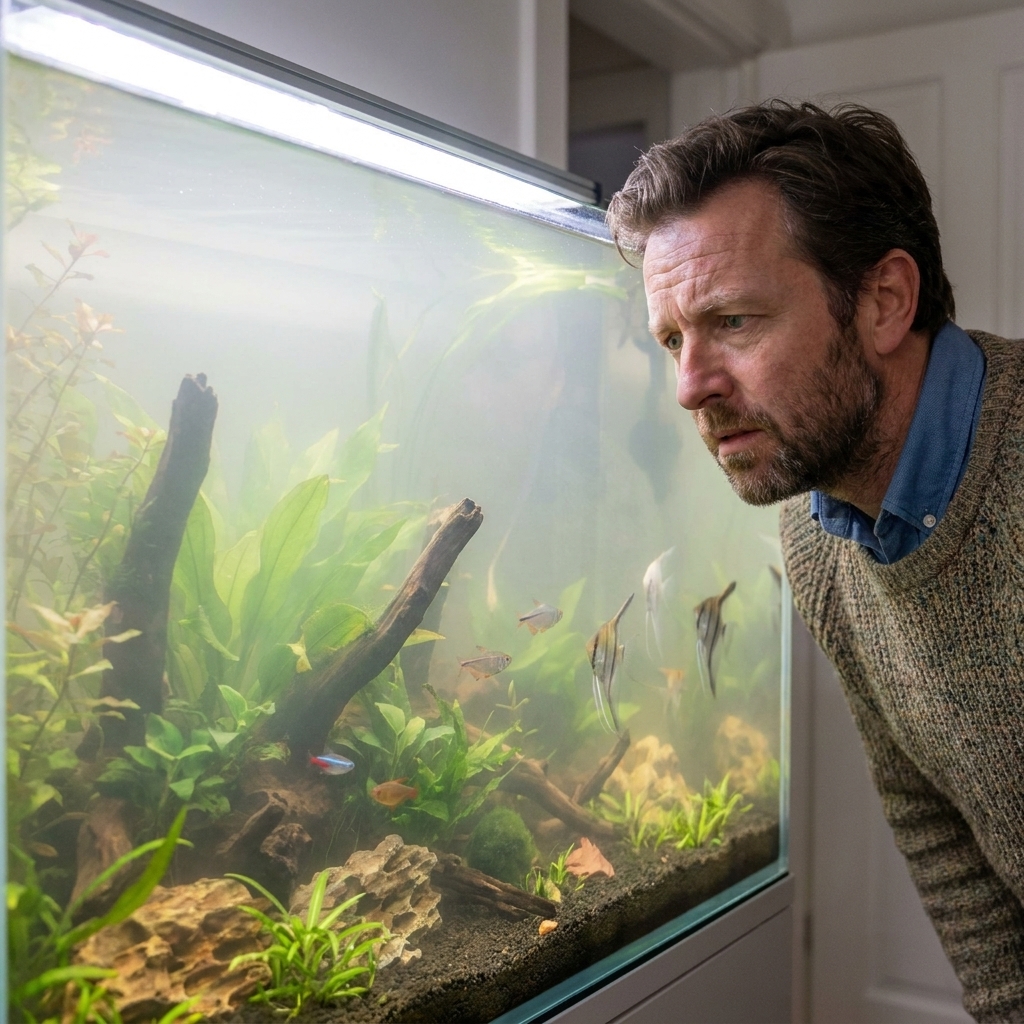
Most cloudy water falls into three buckets: a bacterial bloom (milky white), algae in the water column (green tint), or debris from unwashed substrate or stirred-up detritus (gray or tan particles). Below are the five most common causes I see, how to confirm which one you have, and the fixes that clear the tank without stressing your fish.
Quick diagnosis
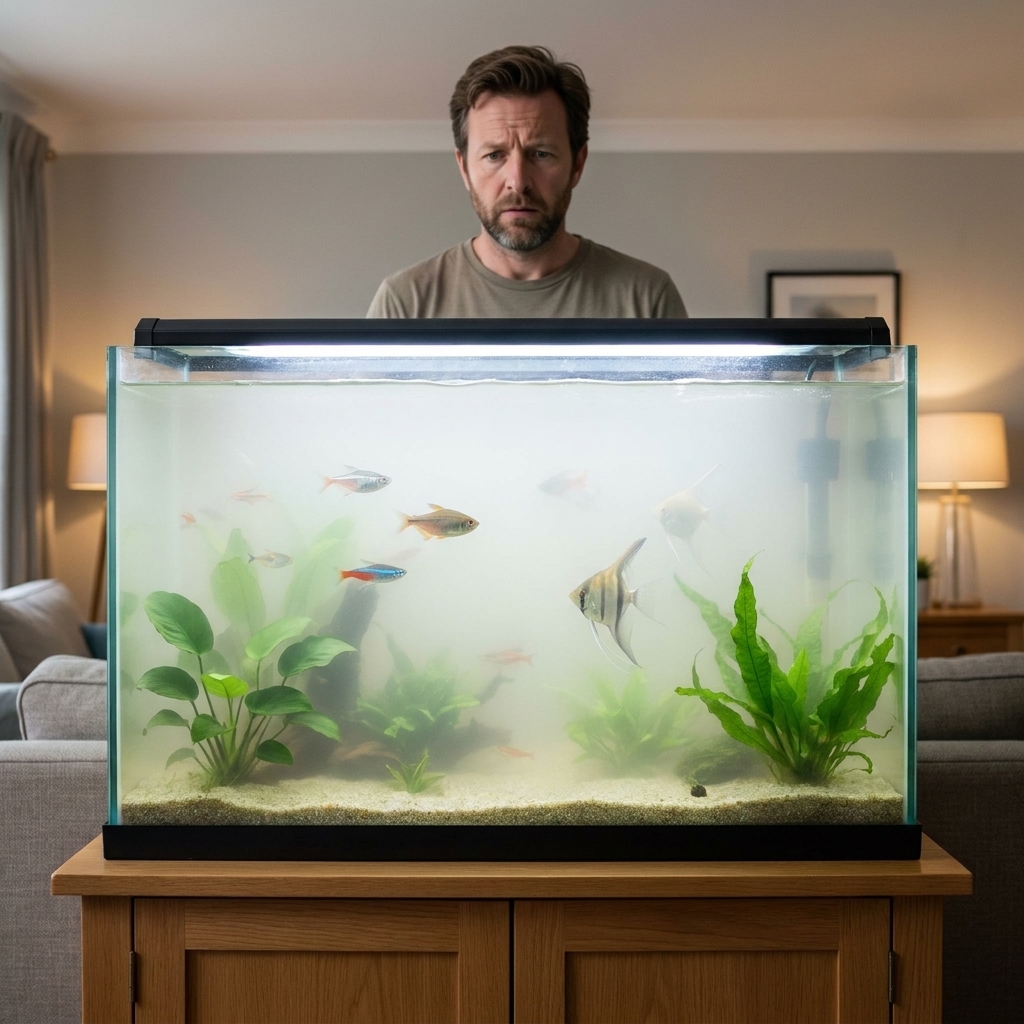
- Milky white haze (like diluted skim milk): usually a bacterial bloom, or sometimes fine sand dust.
- Green water (pea soup or green tint): free-floating algae in the water column.
- Gray or tan cloud with visible specks: debris from substrate, uneaten food, or mulm stirred up.
- White “snow” floating around: often microbubbles after maintenance or a new filter, or fine particulate.
If you are unsure, shine a flashlight through the tank from the side. Particles will sparkle and move with flow. Blooms (bacteria or algae) look more like a uniform fog. Just keep in mind you can have more than one issue at the same time, like a bloom plus stirred-up debris, which can make things look a little sparkly anyway.
Cause #1: Bacterial bloom
What it is: A sudden population boom of heterotrophic bacteria that feed on dissolved organics. This commonly happens in brand-new setups, after deep cleaning, after a big fish addition, or when something decays in the tank.
How to tell
- Water looks milky white or hazy, not green.
- It often appears 24 to 72 hours after a change to the tank (new filter, new fish, heavy feeding, big clean).
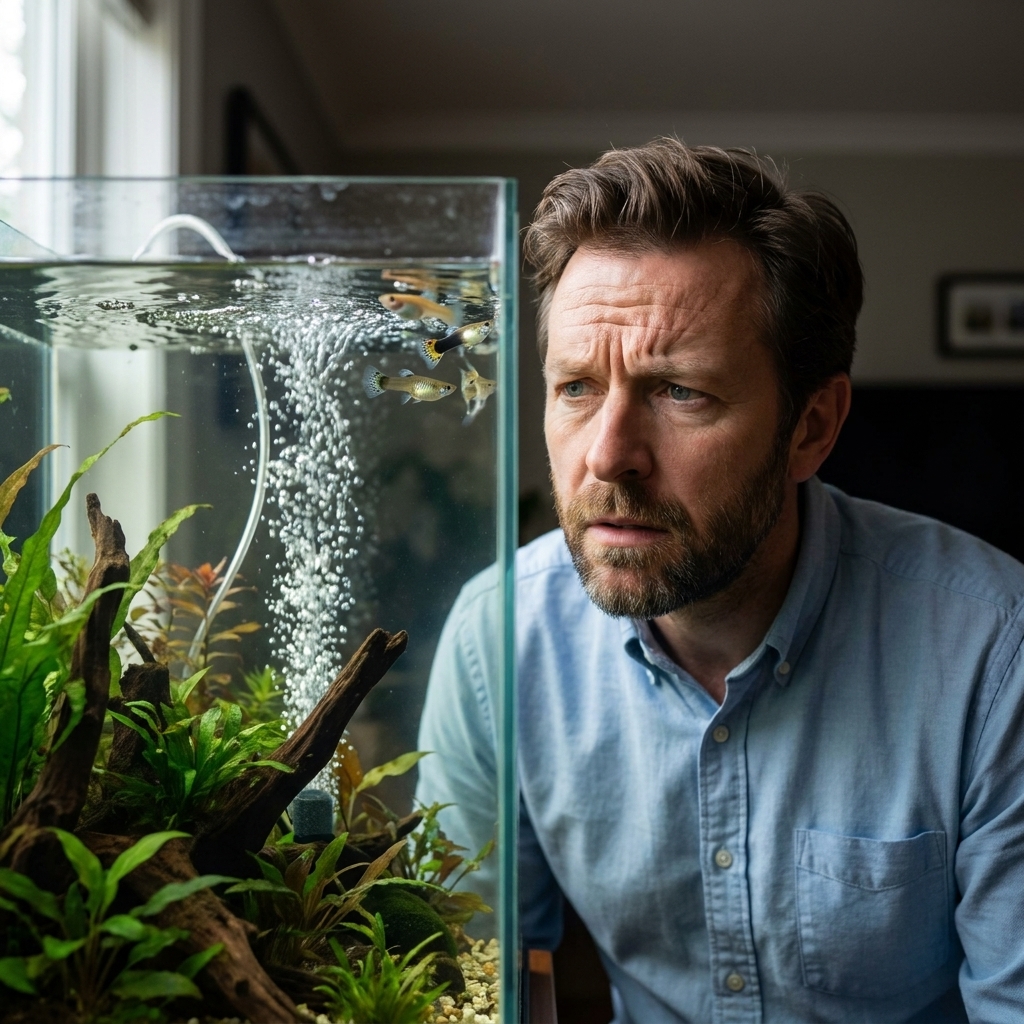
- Fish may breathe a bit faster if the bloom is heavy, because bacteria can reduce available oxygen.
How to clear it
- Do not replace all your filter media. If you throw away beneficial bacteria, you can turn a cloudy issue into an ammonia issue.
- Increase aeration. Add an airstone or raise filter output to agitate the surface. This helps fish and supports stabilization.
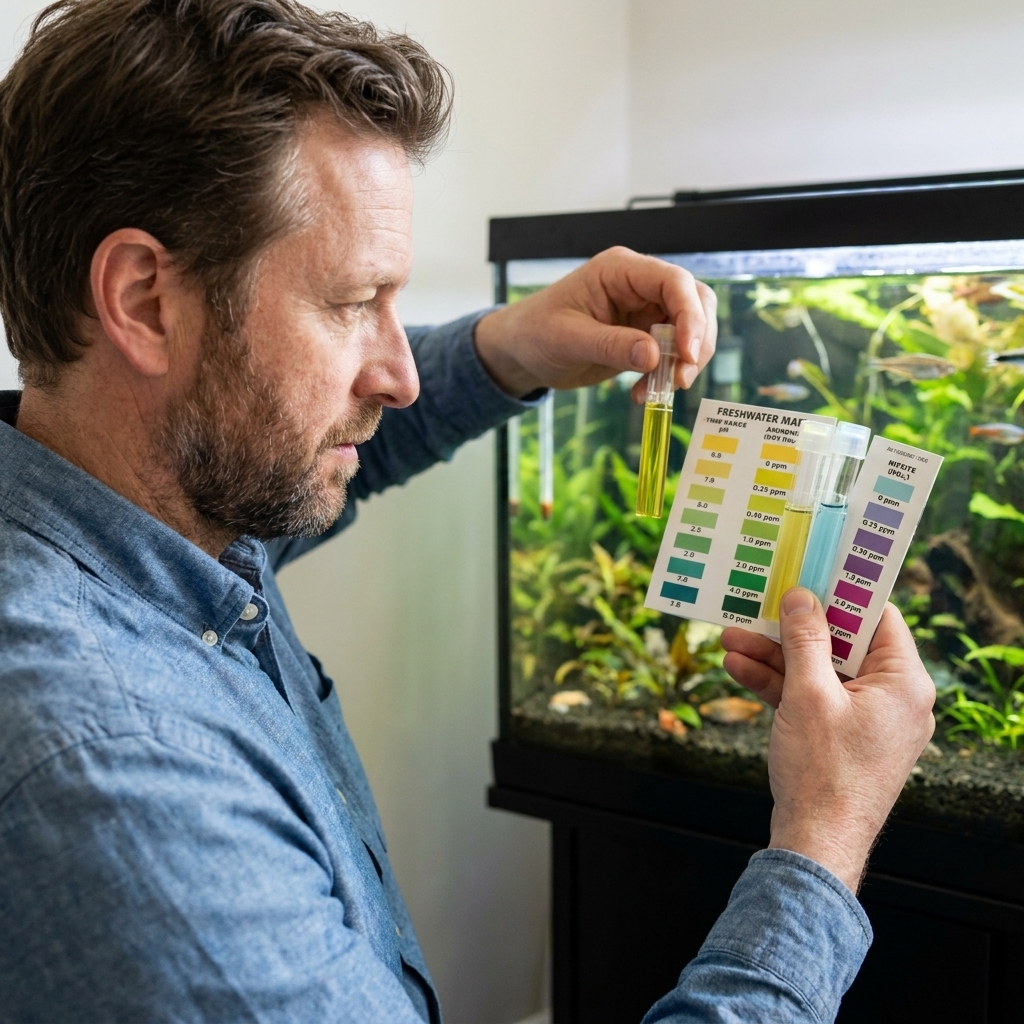
- Test daily for ammonia and nitrite. If either reads above 0 ppm, do a 25 to 50% water change and reduce feeding.
- Feed lightly for a few days. Bacterial blooms thrive on excess food and waste.
- Be patient. In a stable tank, many bacterial blooms clear within about 2 to 7 days, but it can take longer if the tank is overloaded or the source of organics is still in there.
What to avoid: Clarifiers can be useful for particulates, but they should not replace diagnosing the cause. If a bloom is being fed by overfeeding, decaying plants, or a dead snail under a rock, it will keep coming back until you remove the fuel.
Cause #2: Green water
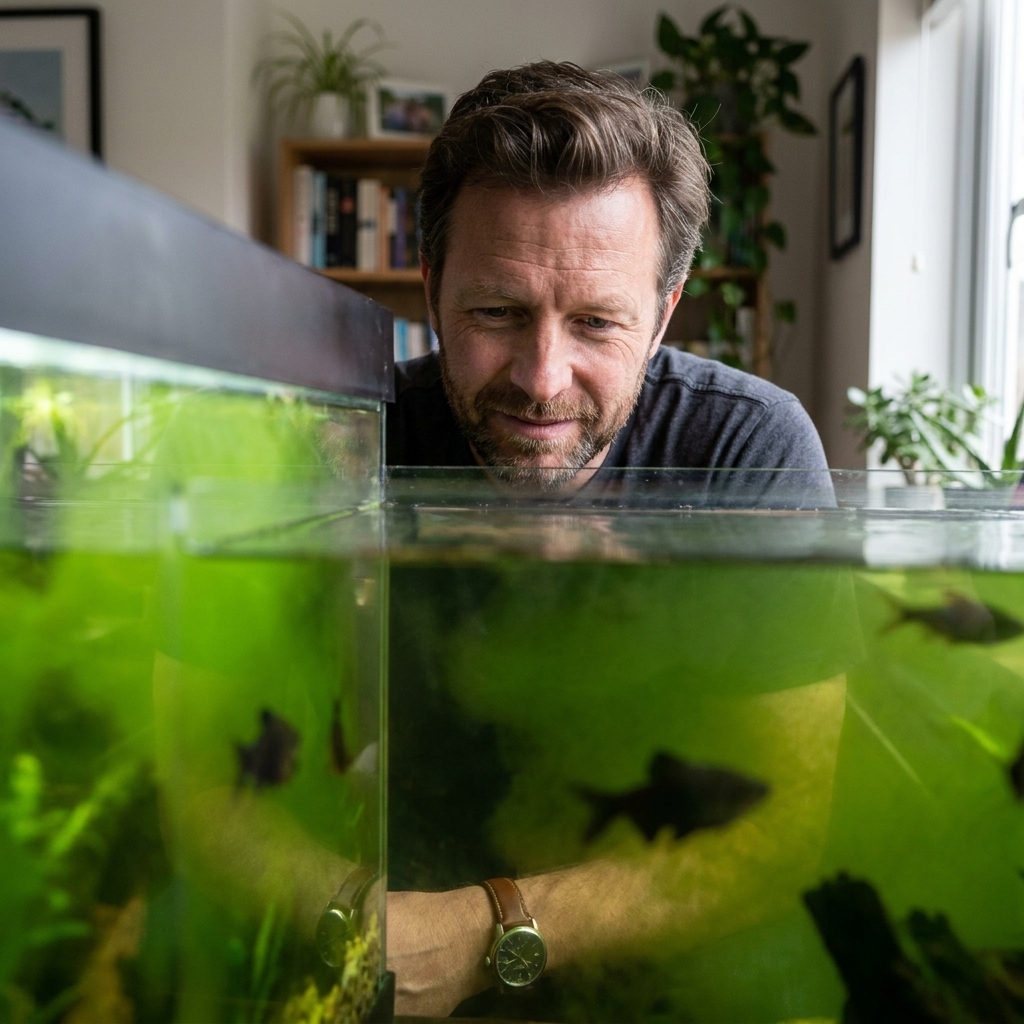
What it is: Microscopic algae suspended in the water column. Unlike algae on the glass, this is the “water itself” turning green. It is driven by light plus nutrients, and it can happen even in tanks with clean glass.
How to tell
- The tank has a green tint or looks like pea soup.
- It often gets worse during the day with lights on.
- Test results may look “fine,” because algae can consume nitrate quickly, hiding the nutrient load.
How to clear it
- Blackout for 3 days: Turn aquarium lights off completely, cover the tank to block ambient room light, and keep feeding minimal. Maintain filtration and aeration. This often knocks blooms back hard.
- Reduce light going forward: Aim for 6 to 8 hours of consistent light, not 10 to 12. Use a timer so your schedule does not drift.
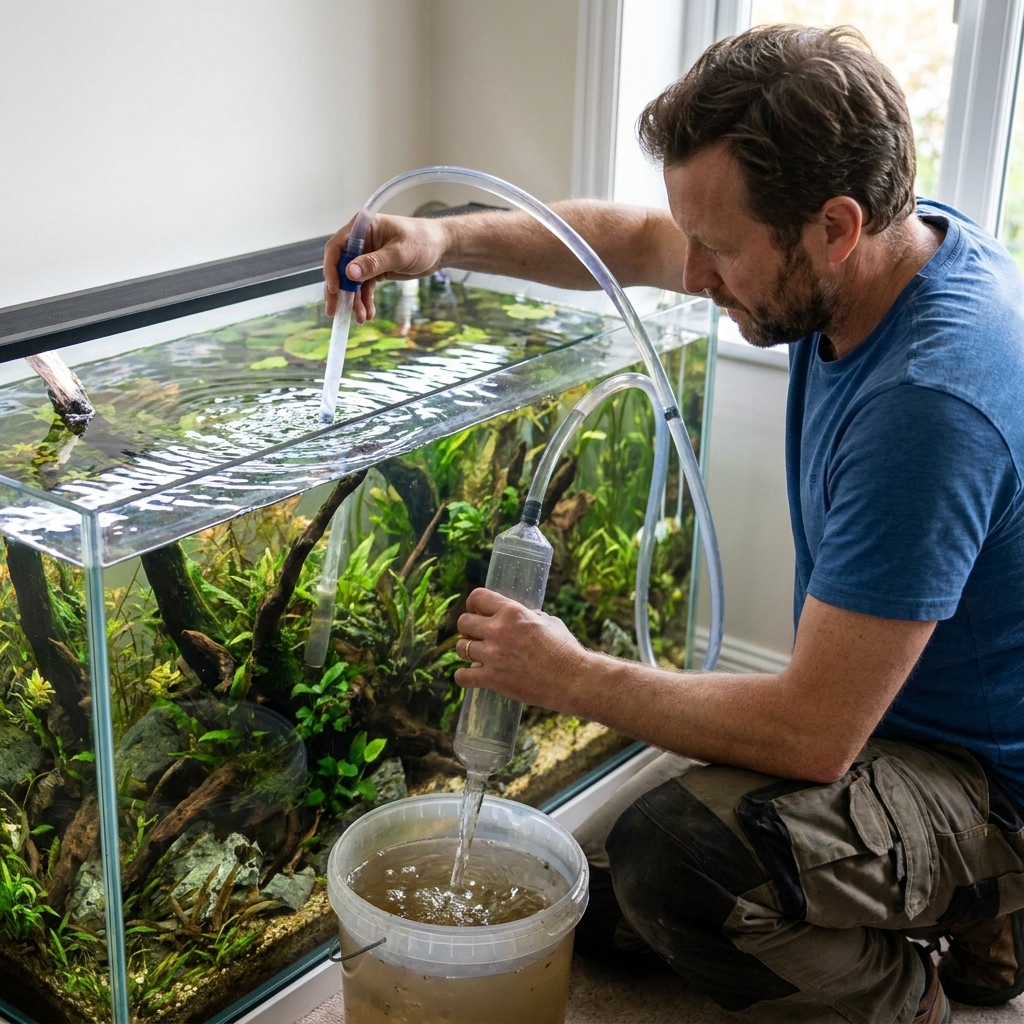
- Big water change plus clean-up: Do a 50% change, vacuum visible debris, and rinse mechanical filter media in removed tank water.
- Consider a UV sterilizer: If green water keeps returning, a properly sized UV can clear it in 24 to 72 hours in many tanks by killing algae in the water column. It does not fix the underlying imbalance, but it is extremely effective at clearing the water.
Long-term prevention: Balance light and nutrients. Heavily planted tanks can be very stable, but only if the lighting duration and intensity match the plant mass and feeding level.
Cause #3: Dusty substrate
What it is: Fine particulate matter from new gravel, sand, rocks, or even some bagged substrates. Sand is the biggest offender because the smallest grains stay suspended for a long time.
How to tell
- Cloudiness starts immediately after setup or after adding new substrate.
- Water looks gray, tan, or chalky rather than milky.
- With a flashlight, you can see tiny particles drifting and sparkling.
How to clear it
- Run fine mechanical filtration. Add filter floss or a fine polishing pad. Swap or rinse it as it clogs.
- Let it settle, then lightly vacuum. After 12 to 24 hours, gently siphon the top layer of dust without digging deep.
- Avoid stirring the substrate. Reduce strong flow pointed directly at the sandbed.
- Time helps. With good filtration, substrate dust often clears within 1 to 3 days, though very fine sand can take longer.
Next time tip: Rinse inert sand and gravel outside the tank until the rinse water runs mostly clear. If you are using nutrient-rich aquasoil, follow the manufacturer guidance, because aggressive rinsing can remove what you paid for.

Cause #4: Waste buildup
What it is: Excess organic waste breaking down into fine particles and dissolved compounds. This can create visible debris, trigger bacterial blooms, or both.
How to tell
- Cloudiness coincides with heavier feeding or missed maintenance.
- You see mulm lifting off the substrate, or debris collecting behind hardscape.
- There is an odor, sudden snail die-off, or a fish is missing.
How to clear it
- Find and remove the source. Check behind rocks, inside ornaments, and under driftwood for trapped food or a dead snail or fish.
- Vacuum strategically. Focus on pockets of waste, not the entire substrate at once if the tank is new.
- Do a 30 to 50% water change. Match temperature, and use dechlorinator.
- Rinse mechanical media in tank water. This restores flow and removes trapped gunk without killing your biofilter.
- Feed less. Most community fish do well with what they can finish in 30 to 60 seconds, once or twice daily.
Important: If you suspect decay, test ammonia and nitrite immediately. Cloudy water is annoying, but ammonia is dangerous.
Cause #5: Mini-cycle
What it is: A partial crash of the nitrifying bacteria that process ammonia to nitrite and then nitrate. This often happens when a filter is replaced all at once, bio media is washed under tap water, or the tank is deep-cleaned too aggressively.
How to tell
- Cloudiness appears after a major cleaning or filter swap.
- Tests show ammonia and/or nitrite above 0 ppm. In a well-cycled tank, any detectable ammonia or nitrite is a red flag, even though very faint readings can sometimes come from test quirks or user error.
- Fish may clamp fins, breathe faster, or hang near the surface.
How to clear it
- Protect your fish first: Do a 25 to 50% water change if ammonia or nitrite is detectable.
- Stop replacing filter media. If you installed a new cartridge, keep it, but add seasoned media if you have it.
- Use a conditioner that claims to bind ammonia and nitrite or temporarily reduce their toxicity, following label dosing. Keep testing and keep up with water changes, because these products are a short-term safety net, not a cure.
- Seed beneficial bacteria if possible. A handful of established filter media from a healthy tank is gold. Bottled bacteria can help, but it works best when paired with stable filtration and oxygenation.
- Test daily until stable. Your goal is 0 ammonia, 0 nitrite.
How to prevent it next time: Clean filters gently in old tank water, and never replace all media on the same day. Stagger changes so bacteria always have a home.
Clarifiers and polishing pads
Clarifiers work by clumping fine particles so the filter can catch them. They can be useful for substrate dust or suspended debris, but they should not replace testing and fixing the root cause, especially in new tanks or after major maintenance. If you use one:
- Make sure your filter has fine mechanical media to actually capture the clumps.
- Do not overdose. Overdosing can sometimes make things worse.
- Do not use clarifier as a substitute for testing ammonia and nitrite if the tank is new or recently disturbed.
Clear water checklist
- Identify the color: milky white, green, or particle-filled.
- Test: ammonia, nitrite, nitrate (and ideally pH, KH if you keep sensitive species).
- Dechlorinate: always treat new water for chlorine or chloramine. Chloramine-treated water can confuse diagnosis because some products break the bond and you may see measurable ammonia afterward.
- Remove the obvious: dead plant leaves, uneaten food, trapped debris.
- Improve mechanical filtration: add floss, clean clogged pads in tank water.
- Increase oxygen: especially during bacterial blooms and warm weather.
- Adjust light and feeding: the two most common long-term drivers of repeat cloudiness.
FAQ
Is cloudy water dangerous to fish?
Cloudiness itself is not always dangerous, but the cause can be. Substrate dust is mostly cosmetic. A bacterial bloom can reduce oxygen. A mini-cycle can expose fish to ammonia and nitrite, which is dangerous. When in doubt, test ammonia and nitrite.
How long does it take to clear?
Substrate dust often clears within 1 to 3 days with fine filtration. Bacterial blooms often clear within about 2 to 7 days once the tank stabilizes. Green water can persist unless you address light and nutrients, though UV sterilizers often clear it within 24 to 72 hours in many setups.
Should I do a 100% water change?
No. Large, total water changes can destabilize temperature, pH, and your biofilter. For most situations, 25 to 50% is plenty, paired with better filtration and addressing the cause.
Why did my tank get cloudy after a water change?
Common reasons include stirring debris, kicking up sand, cleaning the filter too aggressively, or changing too much media at once. Another possibility is microbubbles from new plumbing or a freshly refilled filter, which usually disappear within hours. If your tap water is treated with chloramine, the way it is neutralized can also complicate ammonia readings for a day or so, so retest and look for trends.
What about brown water?
A tea-colored tint is often tannins from driftwood, leaves, or botanicals. That is discoloration, not the same as cloudy water. It is usually harmless, and it typically fades with time, water changes, and optional activated carbon if you want it gone faster.
Still not sure?
If your water is cloudy and you cannot pin down which category it fits, it helps to collect a few basics before you change anything: tank size, how long it has been running, what the cloudiness looks like (milky, green, or particles), any recent changes (new fish, new filter media, big clean, new substrate), and your latest ammonia, nitrite, and nitrate readings. With that information in hand, the cause is usually obvious and the fix is much safer.