A practical breakdown of aquarium water test kits and the parameters that keep freshwater fish safe: ammonia, nitrite, nitrate, pH, KH, GH, plus when to test...
Freshwater aquarium guidance
GH and KH Explained
Learn what GH and KH mean, how they affect fish health and pH stability, and how to test and adjust aquarium hardness safely.

Written by
Oliver Bennett
Oliver Bennett is a lifelong aquarist with over 15 years of experience in freshwater tank setup, aquascaping, and fish health. Through TankRoot, he shares his passion for creating balanced underwater ecosystems, helping hobbyists of all levels build thriving, beautiful homes for their fish.
Published: October 17, 2026
•
Updated: October 17, 2026
If you have ever tested your aquarium water and thought, “Okay… but what is hardness and why does it have two different numbers?”, you are not alone. GH and KH are two separate measurements that often get lumped together at the fish store, then blamed for everything from weird pH readings to fish that never seem to thrive.
In plain terms, GH is about the minerals your fish and plants live in, and KH is about how well your water resists pH swings. Once you understand that split, water chemistry gets a lot less scary.
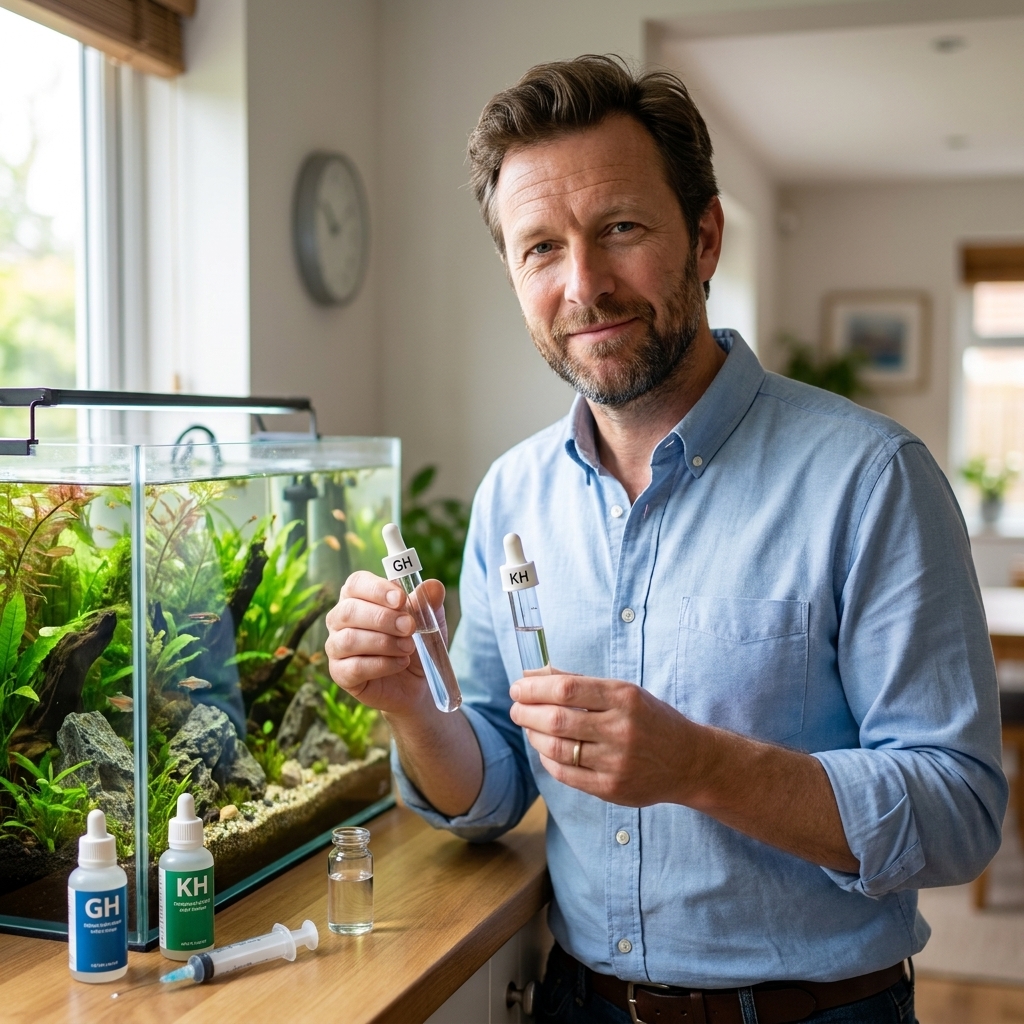
What GH is
GH stands for general hardness. It measures the amount of dissolved divalent minerals in the water, mainly:
- Calcium (Ca)
- Magnesium (Mg)
These minerals influence fish osmoregulation (how fish balance salts and water in their bodies), shell growth in snails and shrimp, and overall long-term vitality. GH is not the same as pH, and GH does not directly tell you whether water is acidic or alkaline.
How GH affects fish health
Fish are constantly exchanging water and ions with their environment through their gills and skin. When GH is far from what a species evolved in, fish can survive for a while but slowly get worn down. You may see:
- Chronic stress (skittish behavior, poor appetite)
- Reduced immunity (more frequent disease outbreaks)
- Poor breeding results (eggs fungus easily, low hatch rates)
- Molting problems in shrimp (especially if GH is too low, or if parameters swing)
- Pitted or eroding snail shells (often low GH, sometimes combined with low pH)
Think of GH as a “comfort zone” parameter. Fish often tolerate a range, but they rarely thrive when consistently kept outside it.
What KH is
KH stands for carbonate hardness. In the aquarium hobby it is often used interchangeably with alkalinity or buffering capacity, but here is the useful nuance: alkalinity is broader (it can include other bases), and in most freshwater aquariums the alkalinity you care about is mostly bicarbonate and carbonate, which is what KH test kits measure.
KH measures carbonate and bicarbonate ions in your water. These act like a shock absorber for acids, helping keep pH from swinging up and down.
Why KH matters for pH stability
In every aquarium, acids are constantly being produced. Common sources include:
- Biological filtration converting ammonia to nitrate (this produces acid and consumes KH over time)
- Decaying food and plant matter
- Driftwood and botanicals releasing tannins
- CO2 injection in planted tanks (temporarily forms carbonic acid)
If KH is reasonably strong, the water can neutralize these acids and the pH changes slowly. If KH is very low, pH can drop suddenly. This is the classic “my pH crashed overnight” scenario, especially in newer tanks or heavily stocked ones.

GH vs KH vs pH
Here is the simplest way to keep it straight:
- GH is the mineral content that directly affects fish, shrimp, snails, and many plant processes.
- KH is the buffering system that helps keep pH stable.
- pH is the current acidity or alkalinity of the water right now.
Two important clarifications:
- You can have high GH with low KH. This happens in some water sources and can surprise people because the water feels “hard,” yet pH still swings.
- You can have low GH with high KH. It is less common, but it can happen. One real-world example is when the source water has decent alkalinity but relatively low calcium and magnesium. Also, be careful with household water softeners. Many “softeners” do not truly remove hardness minerals from the water. They often swap calcium and magnesium for sodium, which can change how water behaves without giving you the GH and KH outcome you expect for an aquarium.
So when someone says, “My hardness is 8,” always ask: GH or KH? They solve different problems.
Units
Test kits may report hardness in different units:
- dGH / dKH: degrees of hardness (common in hobby test kits)
- ppm (mg/L as CaCO3): common on municipal water reports
A handy conversion:
- 1 dGH (or dKH) ≈ 17.9 ppm
Many drop-style kits are simple: each drop equals 1 degree until the color changes.
KH vs total alkalinity on water reports
If your city water report lists total alkalinity, that number can include buffering beyond just carbonate and bicarbonate. In most typical freshwater tap water, it still tracks closely with what hobbyists call KH, but the labels can differ. If you are comparing your test kit to a water report, small mismatches are not unusual.
Beginner ranges
There is no single perfect GH and KH for every aquarium, but there are safe zones that work for many beginner setups when you are prioritizing consistency.
General community targets
- GH: about 4 to 10 dGH
- KH: about 3 to 8 dKH
That range is a decent middle ground for a lot of hardy community fish, but it is not a promise that every tetra and every livebearer will be equally happy in the same water. If you want fish that truly thrive, aim your stocking toward one “direction” or the other.
If your tank leans livebearer
- Guppies, platies, mollies, swordtails generally appreciate higher GH and often do best with more buffering (higher KH) than a soft-water tank.
- Many snails and shrimp benefit from adequate minerals for shells and molts.
If your tank leans Amazon and soft-water fish
- Many wild-type Amazon fish (many tetras, angelfish, discus) prefer lower GH.
- Many dwarf cichlids (Apistogramma) and some rasboras and blackwater species also tend to prefer softer, less mineral-heavy water.
The key is to match your stocking plan to your tap water when possible. Adjusting hardness is doable, but it adds complexity and makes consistency harder for beginners.
How to test GH and KH
For most freshwater keepers, a liquid drop test is the best mix of accuracy and simplicity.
- Test your tap water first, straight from the faucet.
- Then test your aquarium water.
- If you do water changes, test your bucket of new water after you treat it with dechlorinator.
If tap and tank are wildly different, something inside the aquarium is changing hardness. Common culprits include limestone-based rocks, crushed coral, aragonite sand, and some decorative gravels.

Beginner problems
1) “My pH keeps changing every time I test”
This is commonly a KH issue. Low KH means low buffering, so pH drifts with normal tank processes. Instead of chasing pH with chemicals, focus on stabilizing KH and reducing big swings from inconsistent maintenance.
2) “My pH crashed and fish are gasping”
A sudden drop in pH is frequently caused by very low KH combined with a heavy biological load. But gasping is not exclusive to pH crashes. It can also be caused by low oxygen, ammonia or nitrite, or even CO2 overdose in planted tanks. Do not assume it is only KH without checking the basics.
The safer response is usually:
- Do a partial water change with conditioned water (ideally close to the tank’s current temperature and general parameters).
- Increase aeration.
- Test pH, KH, ammonia, and nitrite, and confirm what actually changed.
3) “My guppies keep getting sick, even though ammonia and nitrite are zero”
Livebearers can limp along in soft water, but they often do better long-term with moderate to higher GH and steady KH. If your water is very soft, you may see chronic issues that look like “bad luck” but are really a mismatch between fish and water.
4) “My shrimp are dying after molts”
Molting failures can be tied to low GH (not enough minerals available), but it is rarely just one number. Mineral balance, overall TDS, and especially stability matter. Also, species matter:
- Neocaridina (like cherry shrimp) usually tolerate moderate hardness well.
- Caridina (like many Crystal shrimp) often prefer softer, more controlled parameters.
Shrimp hate sudden swings. If you remineralize or change your water mix, do it consistently and test often.
Change slowly
One warning that solves a lot of heartbreak: rapid hardness changes can shock fish and especially shrimp. Big water changes with water that has very different GH, KH, or pH can cause stress even if your numbers look “better” on paper.
Any time you adjust hardness, aim for steady steps over days, not fast corrections in a single afternoon.
How to raise KH
Raising KH is about increasing buffering in a controlled, repeatable way.
Gentle options
- Crushed coral or aragonite in a filter bag (works gradually, best for tanks that can tolerate slightly higher pH)
- Calcareous rock (only if you actually want harder, more alkaline conditions)
More precise option
- Baking soda (sodium bicarbonate) can raise KH, but it is easy to overdo and it raises pH quickly. If you use it, measure carefully, change slowly, and test after each adjustment.
My rule: raise KH slowly over days, not minutes. Fish can adapt to a stable number. They struggle with rapid change.
How to raise GH
To raise GH, you want calcium and magnesium available in the water.
Best option for most tanks
- Remineralizers designed for aquariums (often marketed for shrimp or for RO water). These are formulated to add calcium and magnesium in predictable ratios.
Options that raise GH and KH
- Crushed coral or aragonite can raise both GH and KH, depending on your baseline water and CO2 levels.
If your goal is specifically GH (minerals) without pushing KH too high, use a product meant to raise GH only and test regularly until you learn how your tank responds.
How to lower GH and KH
Lowering hardness is where a lot of beginners get trapped buying bottles that create instability. In most cases, the cleanest method is dilution with purified water.
Use RO or distilled water mixed with tap
Reverse osmosis (RO) water has very low GH and KH. By mixing RO with tap water, you can hit a target hardness while keeping things consistent.
Example idea (not a universal recipe): If your tap is very hard, mixing half RO and half tap often brings GH and KH down roughly by half. Always confirm with tests, because “very hard” means different things in different cities.
About peat, wood, and “pH down” products
Botanicals and peat can lower pH and slightly influence hardness depending on conditions, but they are not a dependable way to set a precise GH or KH. “pH down” chemicals can create a temporary reading without fixing the underlying buffering issue, which is how people end up with yo-yo pH.
Planted tanks and CO2
Planted aquariums add one extra wrinkle: CO2 changes pH during the day. This is normal. With CO2 injection, your pH will often read lower when CO2 is running and higher when it is off.
- KH helps prevent extreme swings, but you should still expect a daily pH rhythm in CO2 tanks.
- GH supports plant health indirectly. Calcium and magnesium are essential nutrients, and very low GH can contribute to nutrient issues over time.
If you are running CO2, stability becomes even more important than chasing a specific pH number.
Simple process
If you are not sure what to change, work through this in order:
- Test tap GH and KH. This tells you what your water changes are adding every week.
- Choose fish that match your tap when possible. This is the easiest path to a stable tank.
- If pH is swinging, look at KH first. Stabilize buffering rather than fighting pH directly.
- If shrimp or snails are struggling, look at GH. Make sure minerals are adequate and changes are gradual.
- Change slowly and retest. Consistency beats perfect numbers in almost every freshwater aquarium.
Quick FAQ
Can I ignore GH and KH if my fish seem fine?
You can, until you cannot. Many tanks run “fine” for months, then a stressor hits, like a missed water change, a bacterial bloom, a new piece of rock, a big plant trim, and suddenly the lack of buffering shows up as a pH swing. Knowing your baseline GH and KH is like knowing your tank’s blood pressure. It is boring until it saves you.
Is hard water bad for fish?
Hard water is not inherently bad. It is only bad for soft-water species that evolved in mineral-poor habitats. Plenty of popular fish do great in hard water, especially livebearers.
Does high KH always mean high pH?
High KH often correlates with higher pH, but it does not guarantee it. KH is buffering capacity, not the pH value itself.
Should I chase a specific pH?
Most beginners are better off aiming for a stable pH that makes sense for their fish, rather than trying to force an exact number. GH and KH are foundational for that stability.
What is the biggest GH/KH mistake you see?
Using quick-fix pH chemicals instead of addressing KH and consistency. If your tank keeps swinging, it is usually a buffering and maintenance rhythm issue, not a “you need a perfect pH” issue.
Takeaway
If you remember only one thing: GH is the mineral content your livestock lives in, and KH is the buffer that keeps pH from swinging. Test both, know your tap water baseline, and change parameters slowly. Your fish will reward you with calmer behavior, better color, and fewer mystery problems that never show up on an ammonia test.
When you are ready, the next step is learning how your specific fish group prefers to live, then building the tank around that. That is where aquariums stop feeling like chemistry homework and start feeling like an ecosystem.