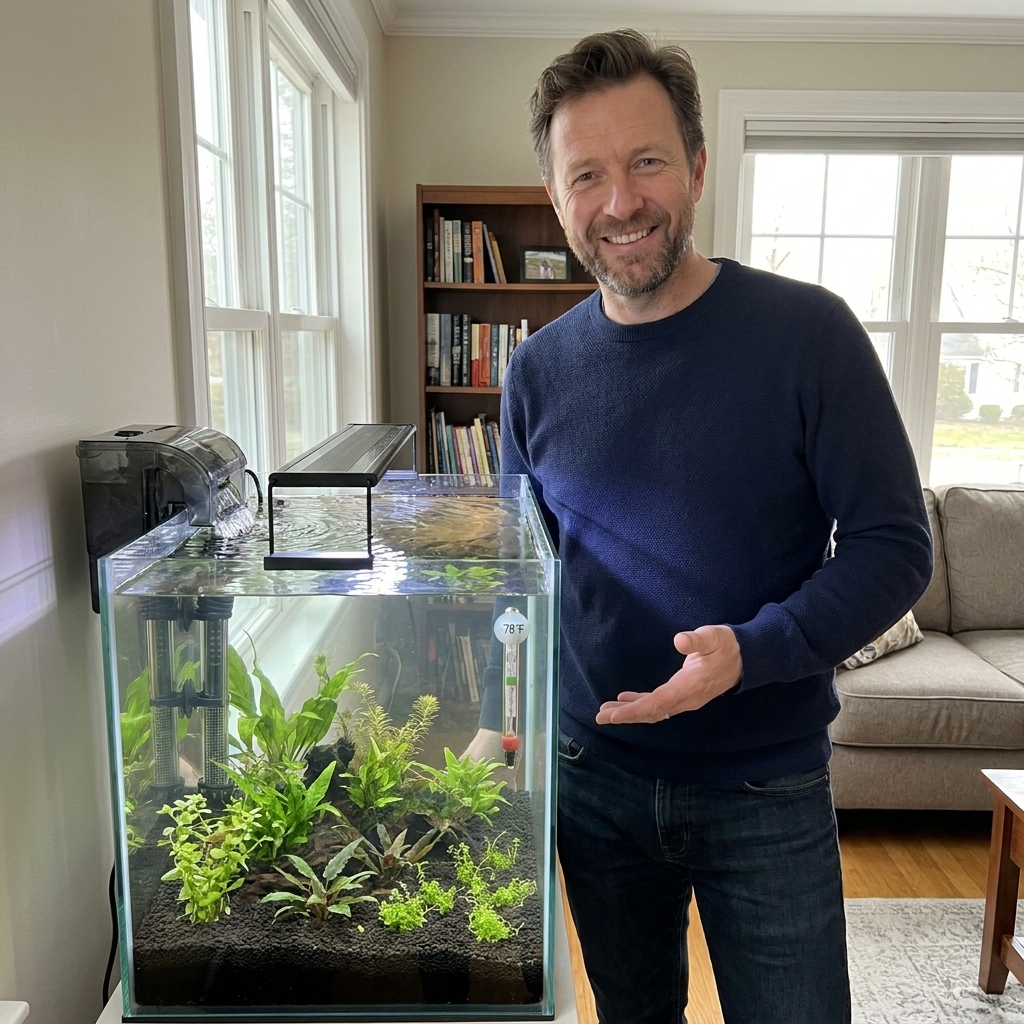
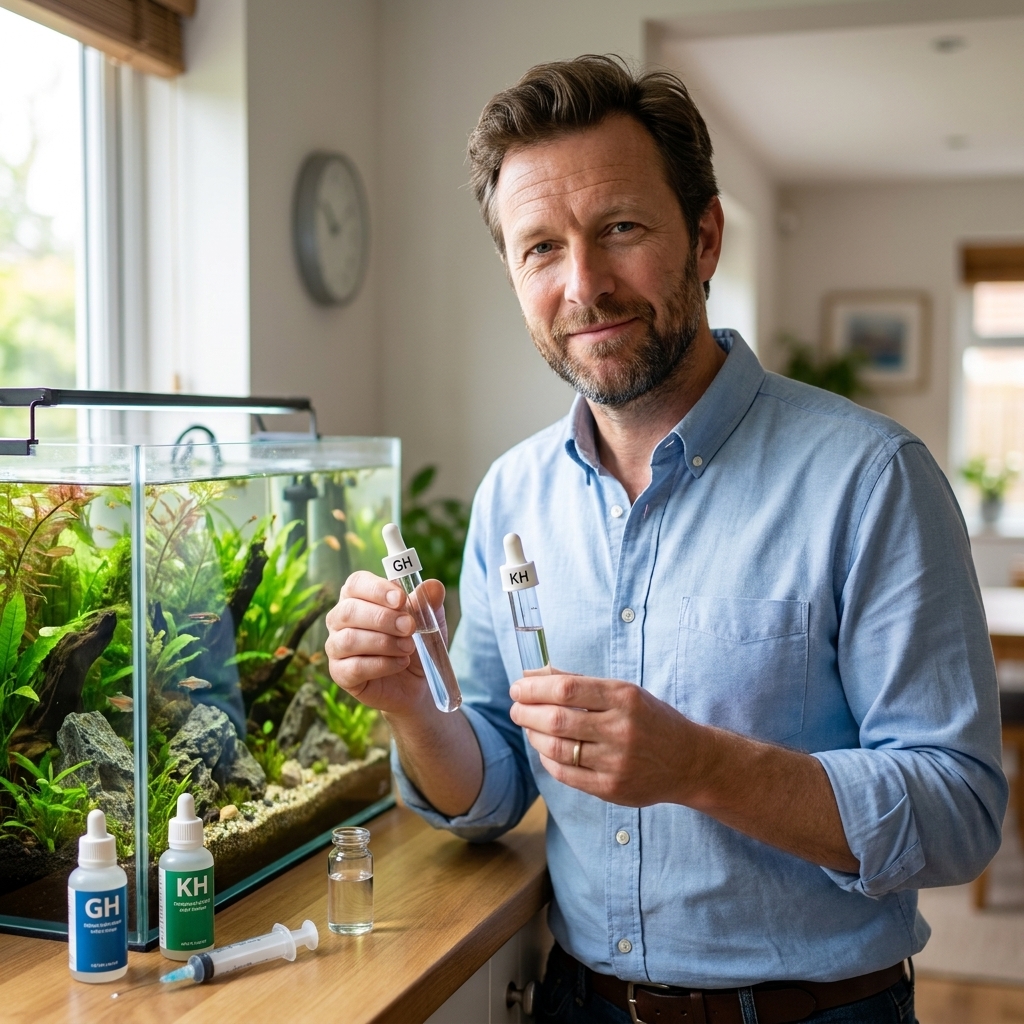
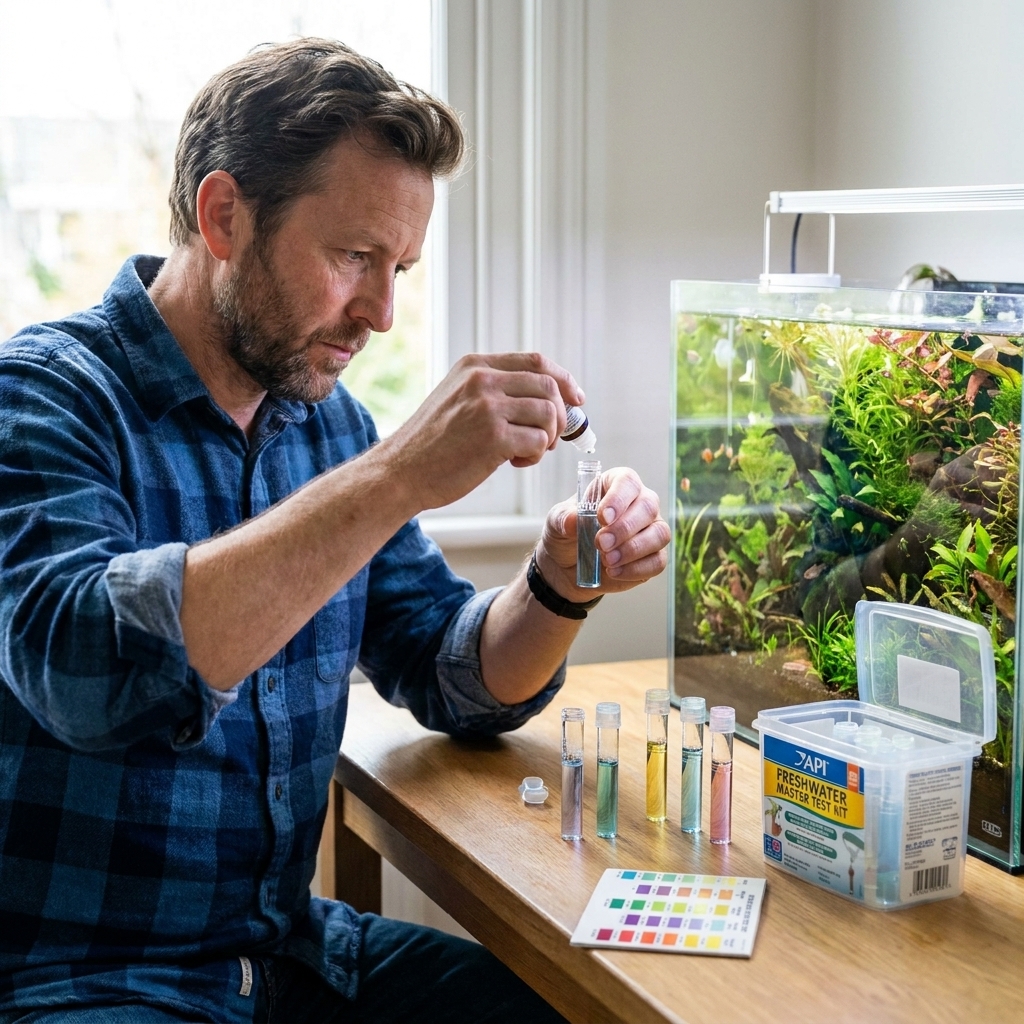
A practical breakdown of aquarium water test kits and the parameters that keep freshwater fish safe: ammonia, nitrite, nitrate, pH, KH, GH, plus when to test...
Freshwater aquarium guidance
The Perfect Aquarium Water Change Routine
Dial in a simple, reliable water change schedule based on your tank size, stocking level, and filtration. Learn exactly how much water to change and how often for stable, healthy freshwater aquariums.

Written by
Oliver Bennett
Oliver Bennett is a lifelong aquarist with over 15 years of experience in freshwater tank setup, aquascaping, and fish health. Through TankRoot, he shares his passion for creating balanced underwater ecosystems, helping hobbyists of all levels build thriving, beautiful homes for their fish.
Published: October 17, 2026
•
Updated: October 17, 2026
If there is one habit that quietly separates problem-prone tanks from “everything just works” tanks, it is a consistent water change routine. Not because water changes are magic, but because they control the two things that slowly drift out of your favor in captivity: pollution (dissolved waste) and stability (the minerals and chemistry your fish, plants, and filter rely on).
The good news is you do not need to chase perfection. You need a routine that matches your aquarium’s bioload, feeding, plants, and filtration. I will show you how to choose the right percentage and schedule, then how to adjust it with real signals from your tank, not guesswork.
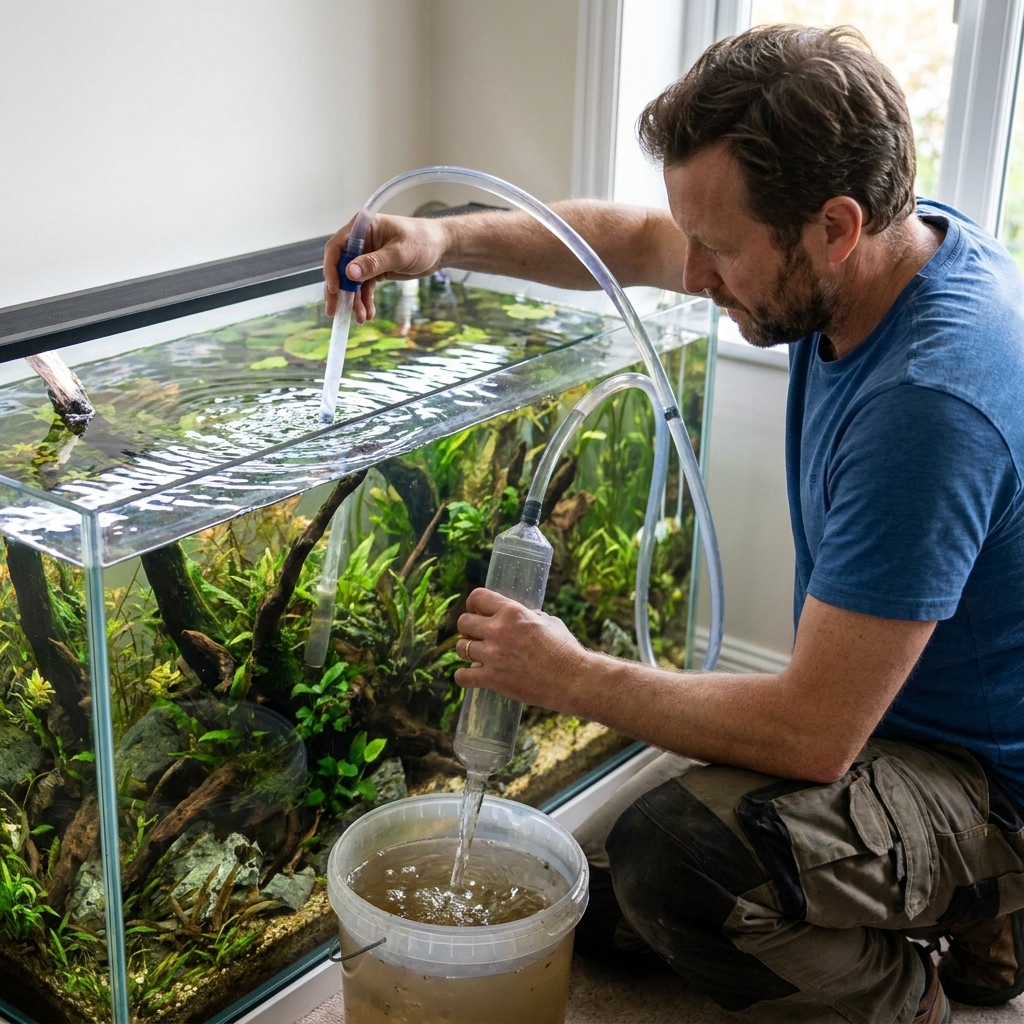
What water changes do (and do not)
Water changes are your main tool for diluting what your tank produces and replenishing what your tank gradually loses.
They help by:
- Reducing nitrate and other dissolved organics that build up between maintenance sessions.
- Diluting dissolved waste that mechanical filtration cannot physically “catch.” (Sponges and floss can trap particles, but not what is truly dissolved.)
- Removing detritus when paired with siphoning, especially in dead spots where debris settles.
- Preventing gradual mineral drift. Nitrification consumes alkalinity (KH) over time, and plants and animals uptake some minerals. Water changes help prevent depletion and ionic imbalance, especially in soft-water setups.
- Supporting fish health by keeping chronic stress lower. Many “mystery issues” in community tanks are commonly tied to long-term water quality, not one sudden event.
They do not:
- Replace cycling. A new tank still must establish a biofilter to process ammonia and nitrite.
- Fix bad stocking. Too many fish can overwhelm even frequent changes.
- Erase the need for testing. Your water change routine should be driven by data at first, then verified occasionally.
A baseline routine for most freshwater tanks
If you want a safe starting point that works for the majority of community aquariums, use this:
- 25 to 35% once per week for an average stocked freshwater tank (typical community fish, moderate feeding, decent filtration).
Why this range? It is large enough to meaningfully dilute nitrate and dissolved organics, but small enough that you are unlikely to swing temperature, pH, or hardness if you dechlorinate properly and match temperature.
From there, you adjust based on stocking level, plant mass, and what your tests and fish are telling you.
Pick a schedule by stocking level
Instead of obsessing over gallons, think in terms of bioload: how much waste your tank produces relative to its water volume and filtration.
Lightly stocked (or heavily planted)
Recommended: 15 to 25% weekly, or 25 to 35% every 2 weeks.
- Examples: a planted nano with a small school of micro fish, a moderate community tank with lots of fast growers, a shrimp-focused tank.
- Goal: keep nitrate reasonable and minerals stable without constantly stripping nutrients from plants.
Moderately stocked (most community tanks)
Recommended: 25 to 40% weekly.
- Examples: typical 20 to 55 gallon community with tetras, rasboras, livebearers, corydoras, a dwarf gourami, etc.
- Goal: consistent nitrate control and lower buildup of dissolved organics that can irritate gills over time.
Heavily stocked, messy fish, or high feeding
Recommended: 40 to 60% weekly, or 25 to 40% twice per week.
- Examples: goldfish, large cichlids, overstocked grow-out tanks, tanks with heavy frozen food feeding, aquariums with chronic algae paired with heavy nutrients.
- Goal: prevent nitrate creep and keep water clarity and oxygen levels high.
Special case: new or unstable tanks
If the tank is new, you are fish-in cycling, or you have had a recent crash event (overfeeding incident, dead fish you did not find quickly, filter outage), lean on water changes more aggressively.
- Recommended: 25 to 50% as needed to keep ammonia and nitrite at 0. In some situations that can mean daily changes until things stabilize.
Use nitrate as your adjustment knob
For most freshwater community tanks, nitrate (NO3) is the easiest “big picture” number to track over time. It is not the only pollutant, but it is a useful proxy for how fast waste is accumulating compared to your maintenance.
Practical nitrate targets
- Planted tanks: often run happily anywhere from 10 to 30 ppm, depending on plant density and fertilization approach.
- Non-planted or lightly planted community tanks: a common goal is under 20 ppm when achievable, with 20 to 40 ppm as a practical upper range for many hardy community species.
- Sensitive fish, invertebrates, and fry: lower is generally better. Many breeders try to keep nitrates under 10 to 20 ppm.
If your nitrate climbs more than you like between water changes, you have three levers:
- Change more water (bigger percentage).
- Change water more often (same percentage, shorter interval).
- Reduce inputs (less food, fewer fish, better mechanical filtration, more plant mass).
Important: if your tap water already contains nitrate, your “lowest achievable” number may not be 0. In that case, focus on keeping it close to your tap baseline and stable.
Tank size matters (in a surprising way)
Small tanks do not “need” smaller water changes. They typically need more consistent ones because chemistry changes faster in a small volume of water.
Nano tanks (2 to 10 gallons)
- Common starting range: 20 to 30% once or twice per week.
- Because evaporation and feeding have a bigger impact, I prefer two smaller changes over one massive swing.
Mid-size tanks (10 to 55 gallons)
- Typical range: 25 to 40% weekly.
- This is where the classic weekly routine shines.
Large tanks (55 gallons and up)
- Typical range: 20 to 40% weekly, adjusted by stocking.
- Large water volumes are naturally more stable, but do not let that trick you into neglect. Waste still accumulates, just more quietly.
Planted vs non-planted tanks
Plants can reduce nitrate and compete with algae, but they do not eliminate the need for water changes. What they often change is the reason you do them.
Heavily planted, balanced aquascapes
- You may see slower nitrate accumulation, but dissolved organics can still build up.
- Water changes help reset organics and replenish minerals, especially if you run soft water or use RO.
- Typical routine: 20 to 35% weekly.
Low-tech planted tanks (slow growers, low light)
- These can accumulate organics faster than you expect because plant growth is slower.
- Typical routine: 25 to 40% weekly, based on stocking.
Non-planted tanks
- No plant uptake means nitrate and organics rely mainly on water changes and filtration export.
- Typical routine: 30 to 50% weekly for many setups, especially if stocking is moderate to heavy.
How to change water without stressing fish
Most fish do not fear “new water.” They fear rapid change. The goal is to make the new water match the old water closely enough that fish barely notice.
My stress-free checklist
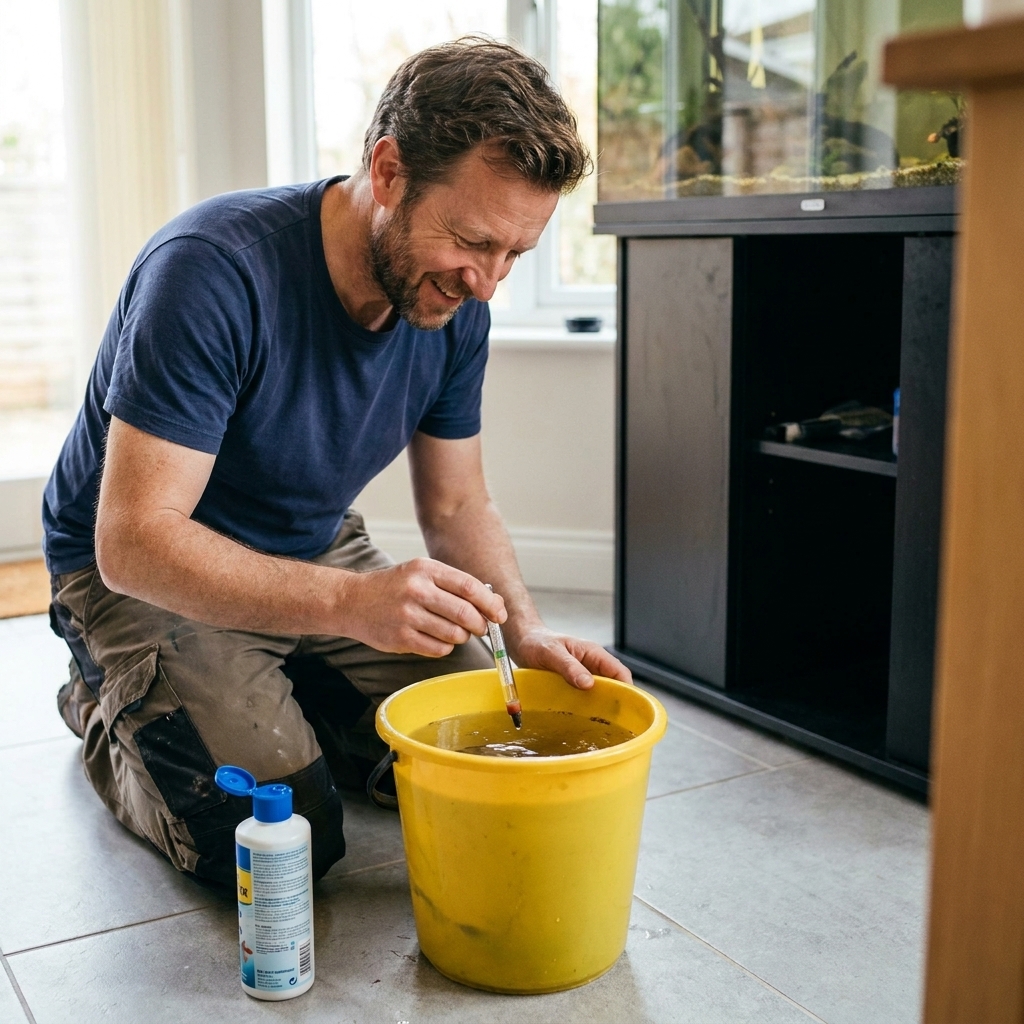
- Dechlorinate every drop of new water. Chlorine and chloramine damage gills and can harm beneficial bacteria.
- Follow the label for chloramine systems. Many conditioners are dosed for the total amount of new water treated, but some products instruct dosing for the full tank volume when adding water directly to the aquarium. When in doubt, read the bottle and dose accordingly.
- Match temperature within about 1 to 2°F (0.5 to 1°C) for most tropical community fish.
- Refill gently. Pour onto a plate, use a diffuser, or a pump with a hose to avoid blasting substrate and fish.
- Vacuum strategically. You do not need to deep-clean every inch weekly. Rotate areas so you remove debris without constantly uprooting plants or stressing bottom dwellers.
- Do not sterilize the filter. Rinse sponges or media only in removed tank water, not under the tap, and only when flow is reduced.
What about pH swings?
Chasing a specific pH number is a common beginner trap. Most community fish tolerate a range of pH values, but they do poorly with frequent swings. If your tank pH differs from your tap, that is usually tied to KH, CO2, tannins, or active substrates. In those cases, focus on:
- Smaller, more frequent changes instead of huge ones.
- Consistency in how you treat water, especially if you use RO water or mineral additives.
Quick note for shrimp and invertebrates
Shrimp and many snails can be more sensitive to GH, KH, and TDS swings than typical community fish. If you keep Neocaridina, Caridina, or delicate invertebrates, prioritize consistency: smaller changes more often, temperature matching, and predictable remineralization if you use RO water. When in doubt, test GH and KH occasionally and avoid sudden shifts.
Quick starting points
Use these as “day one” routines, then refine using nitrate and fish behavior.
- 10 gallon betta community (betta plus a few small tankmates): 25 to 35% weekly.
- 20 gallon community: 25 to 40% weekly.
- 29 to 40 gallon community: 25 to 40% weekly.
- 55 gallon planted community: 20 to 35% weekly.
- Goldfish tank: 40 to 60% weekly, often more if stocking is high.
- Fry or quarantine tank: smaller, frequent changes (often 10 to 30% daily or every other day) depending on feeding.
If you only remember one rule: more food and more fish means more water changes.
Signs you should change more (or less)
Increase volume or frequency if you notice:
- Nitrate creeping higher each week even though you are changing water regularly.
- Yellowing water, “old tank” smell, or reduced water clarity.
- Fish spending more time at the surface, clamped fins, or unexplained lethargy after you have ruled out temperature and disease.
- Persistent algae along with heavy feeding, rising nitrate, and visible waste buildup. (Algae is multifactorial, so also review lighting duration, plant mass, flow, and nutrient balance.)
You may be changing too aggressively if:
- Fish act shocked right after refills (darting, flashing, heavy breathing) despite dechlorination.
- Plants constantly melt or stall and your parameters swing noticeably after each change.
- Your tap water is very different from your tank water and you do large changes infrequently.
In that last scenario, the fix is usually smaller changes more often, not “never change water.”
Common water change mistakes
“Water changes remove beneficial bacteria”
Your beneficial bacteria live on surfaces: filter media, substrate, decor, and plant leaves. They are not floating around in the water in meaningful amounts. A water change does not “uncycle” a tank. Rinsing your filter media under chlorinated tap water can, though.
“Just top off evaporation”
Topping off replaces water, not waste. Evaporation leaves minerals behind, so frequent top-offs without water changes can increase hardness and dissolved solids over time.
Clarifying point: topping off is still normal and often necessary between water changes. Just do not confuse a top-off with a water change.
“Do one huge change only when it looks dirty”
By the time a tank looks dirty, dissolved organics have usually been building for a while. Fish often experience chronic stress long before the water looks bad. Regular small-to-medium changes beat occasional massive “rescue” changes.
“Vacuum the gravel aggressively every time”
Light gravel vac is great. Ripping through the entire substrate weekly in a planted or mature tank often causes more problems than it solves. Rotate sections and let your filter and biology do their job.
FAQ
Is 50% too much?
Not automatically. A 50% change is safe in many tanks if the new water is dechlorinated and closely temperature-matched. It can be very helpful for goldfish, heavy stocking, or high feeding. If your tank water chemistry is quite different from your tap, consider smaller changes more often to avoid swings.
Can I do water changes every day?
Yes, especially in quarantine, fry grow-out, or during cycling, as long as you match temperature and dechlorinate properly. Daily 10 to 30% changes are common in fish rooms and breeder setups.
Should I remove fish during a water change?
No. Catching fish is usually more stressful than the water change. The exception is a true emergency where you need to fully drain for a leak or contamination issue.
Do I need to add bacteria after every water change?
In a stable tank, no. Focus on protecting your filter media (no tap rinsing) and keeping chlorine out of the aquarium. Bottled bacteria can be useful when starting a new tank or after a major disruption, but it is not a weekly requirement.
Do I need to test anything besides nitrate?
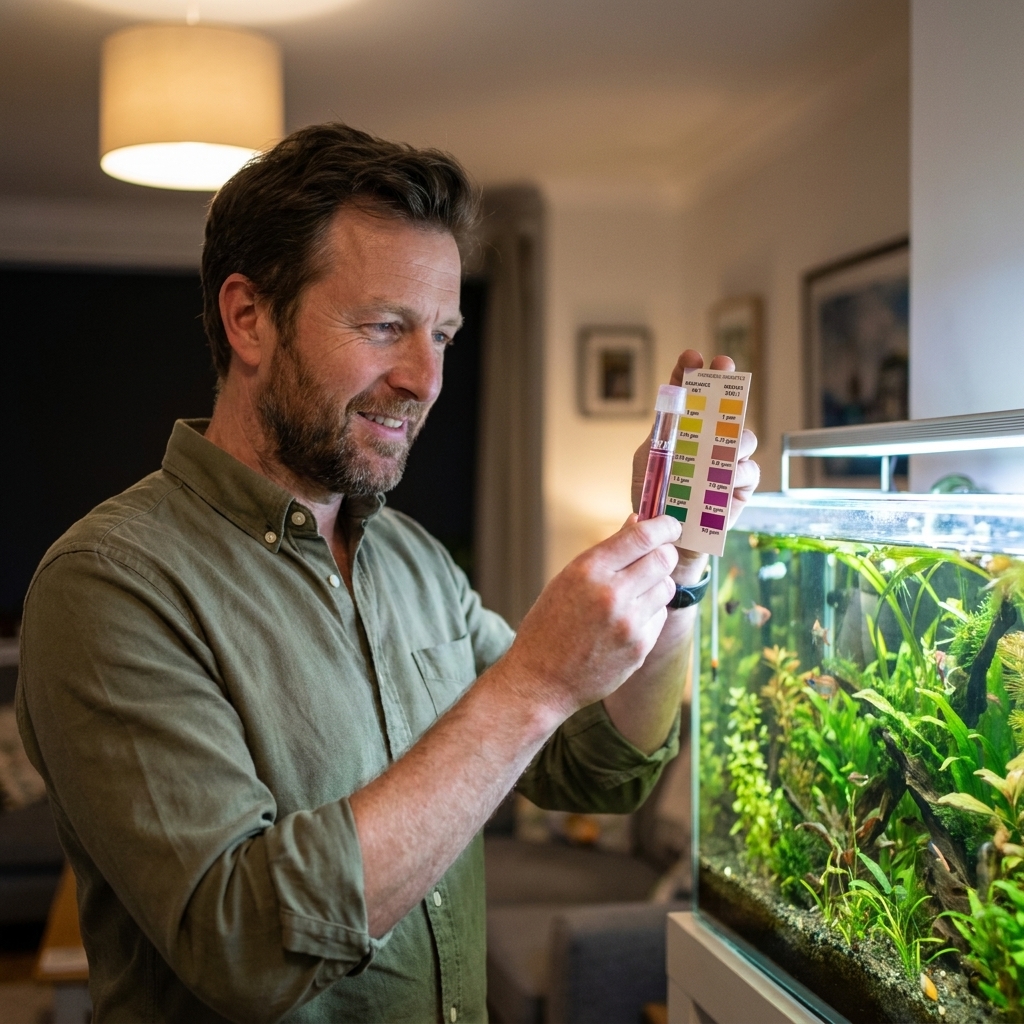
Nitrate is a great trend line, but in soft-water tanks it is smart to check KH and pH occasionally. KH can slowly drop as the tank processes waste, and low KH can make pH less stable.
What is the simplest routine for a beginner?
Set a repeating day each week and do 30% weekly. Test nitrate weekly for the first month. If nitrate rises faster than you like, increase to 40% weekly or add a second smaller change midweek.
A routine you can stick to
The perfect water change routine is the one that keeps your fish healthy and fits your life. Start with 25 to 35% weekly, then let nitrate trends, feeding habits, and fish behavior guide your adjustments. If you ever feel stuck, remember this: consistency beats intensity. A steady routine keeps parameters stable, and stable water is what most freshwater fish are really asking for.