Cloudy aquarium water is frustrating, but it is usually fixable once you identify the cause. Here are 5 common reasons, how to tell them apart, and the safes...
Freshwater aquarium guidance
How to Fix Cloudy Aquarium Water
Cloudy aquarium water is almost always fixable. Learn what milky, green, or brown haze means, what to test first, and safe steps to get your tank clear again.

Written by
Oliver Bennett
Oliver Bennett is a lifelong aquarist with over 15 years of experience in freshwater tank setup, aquascaping, and fish health. Through TankRoot, he shares his passion for creating balanced underwater ecosystems, helping hobbyists of all levels build thriving, beautiful homes for their fish.
Published: October 17, 2026
•
Updated: October 17, 2026
Cloudy aquarium water can feel like betrayal. You do a water change, wipe the glass, and somehow the tank looks worse the next morning. I have been there. The good news is that most cloudiness falls into a handful of predictable categories, and once you match the look of the cloudiness to the cause, the fix becomes straightforward.
This guide covers the three big “types” you will see in freshwater tanks: milky white haze, green water, and brown or gray murk. I will also cover what to test first, what to do today, and what to change so it does not keep coming back.
First: fish safety
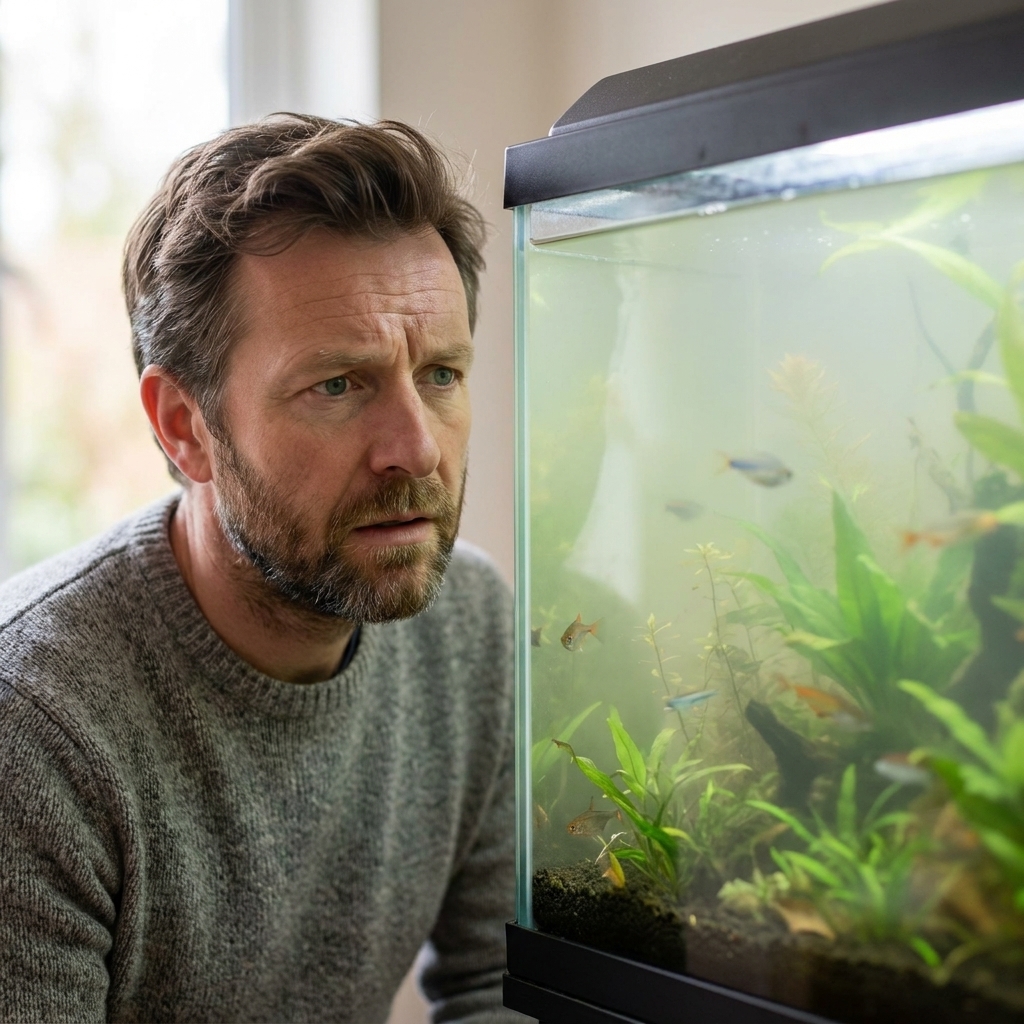
Before chasing clarity, make sure your fish are not in immediate trouble. Cloudy water is often harmless on its own, but the underlying cause can be dangerous.
Red flags that need action now
- Fish gasping at the surface or rapid gill movement
- Strong odor (rotting, sulfur, or “sewer” smell)
- New tank less than 4 to 6 weeks old with no proven cycle
- Ammonia or nitrite above 0 ppm
If you see any red flags, do this immediately: perform a 30 to 50% water change, match temperature as closely as you can, and add dechlorinator for the full tank volume. Then increase surface agitation (aim the filter output to ripple the surface or add an airstone).
If your tap water differs drastically in temperature or pH from the tank, do a couple of smaller changes instead of one huge one. The goal is safer fish, not speed at any cost.
Identify the color
You can save a lot of time by describing the water accurately. Different “cloudy” looks point to different problems.
Quick visual guide
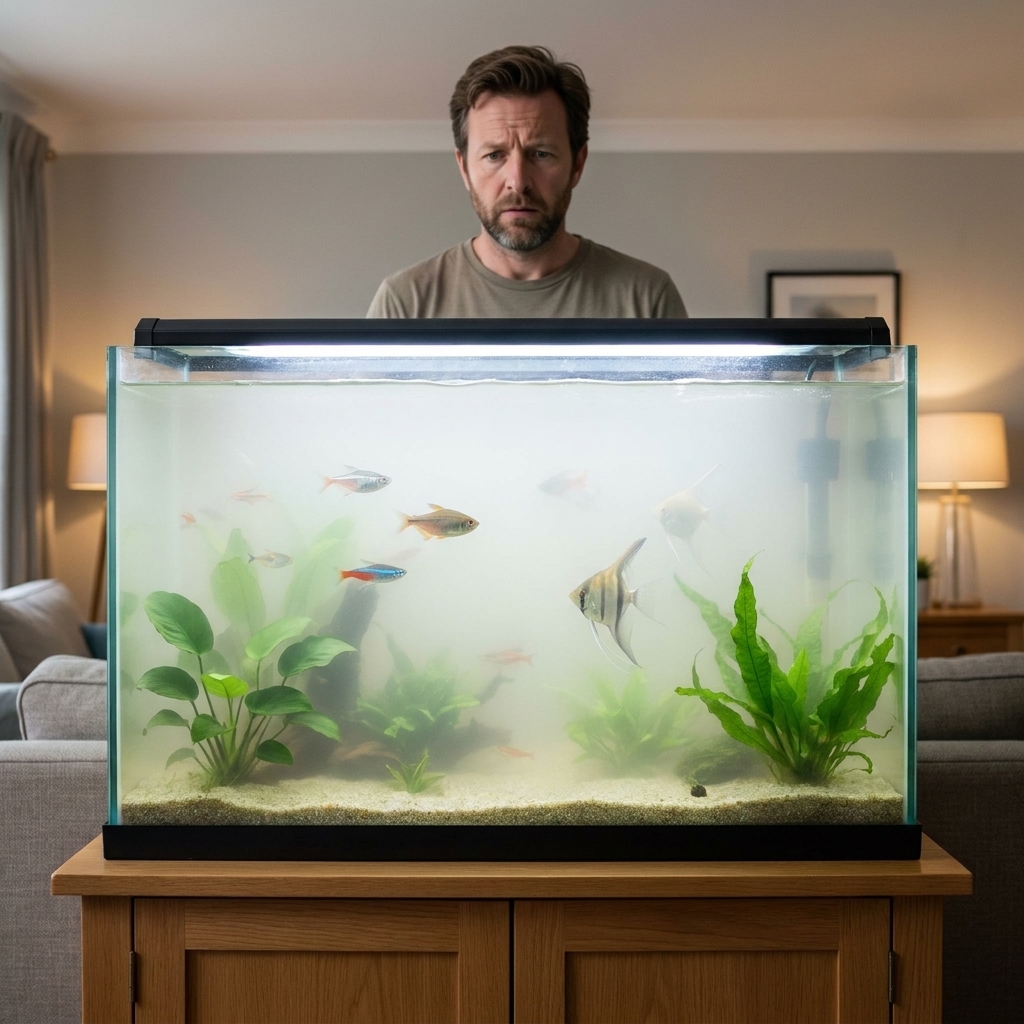
- Milky white or gray haze: usually bacterial bloom, suspended dust, or mineral precipitation
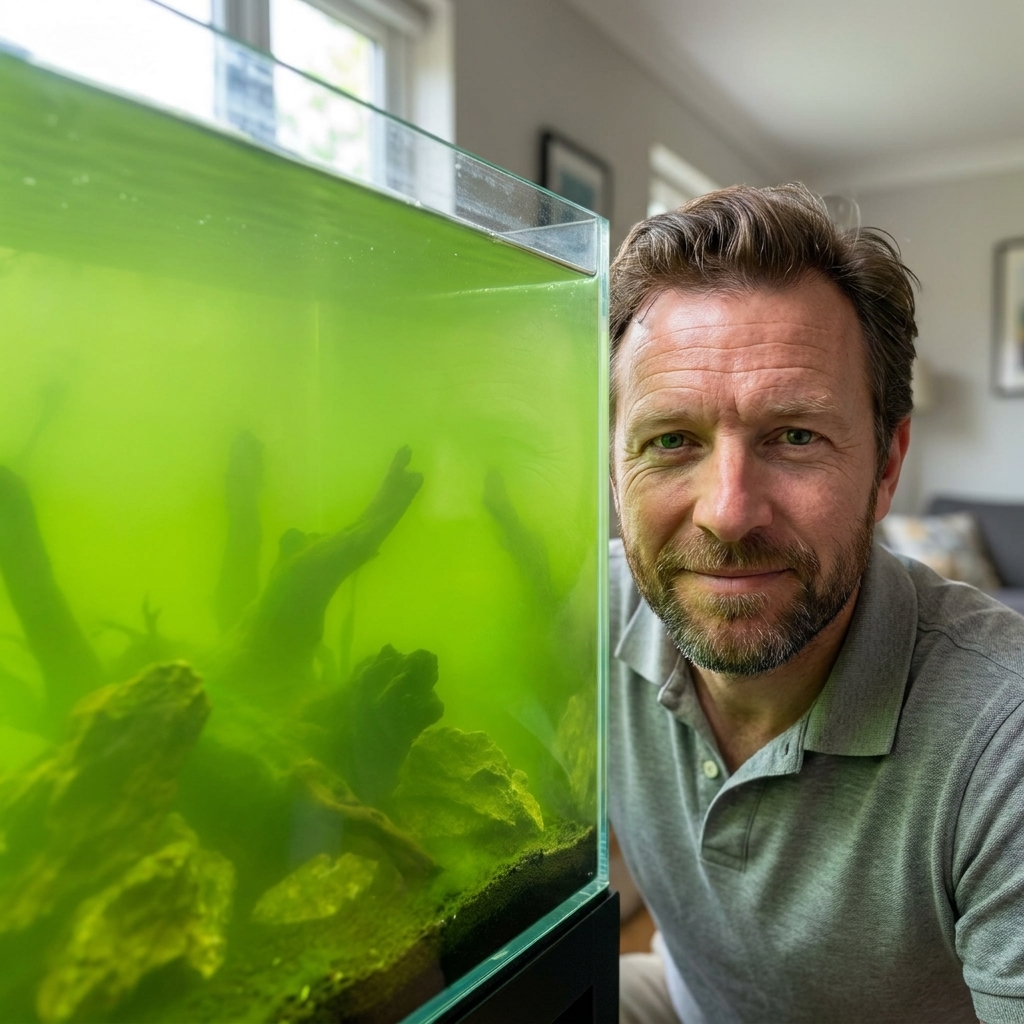
- Green water (pea soup): free floating algae bloom
- Brown tint or murk: tannins, stirred detritus, dirty substrate, or clogged filtration
What to test first
If you own one test kit, make it a liquid kit that measures ammonia, nitrite, nitrate, and ideally pH. Cloudiness is often a symptom of instability.
Good targets for most community tanks
- Ammonia: 0 ppm
- Nitrite: 0 ppm
- Nitrate: often best under 20 to 40 ppm (species dependent)
- Temperature: stable and appropriate for your fish
If ammonia or nitrite is not zero, treat the situation like a cycling problem, even if the tank is “not new.” A filter crash, overcleaning, overfeeding, or a dead fish hidden behind hardscape can push a tank backwards fast.
Milky white water
White cloudiness is the most common complaint I see, especially in new setups and freshly “deep cleaned” tanks.
Cause 1: bacterial bloom
This looks like a uniform white haze, often appearing overnight. It is caused by a population boom of heterotrophic bacteria feeding on excess organic material. It is common during the first few weeks of a new tank, after a big substrate stir, after adding a lot of new fish at once, or after rinsing filter media in tap water.
Even when parameters look “fine,” keep an eye on fish behavior during a bloom. These bacteria can consume oxygen, especially overnight.
What to do:
- Stop over-cleaning. Do not replace filter cartridges or scrub everything “sterile.”
- Do not stack major cleanings. Avoid cleaning the filter and doing a deep gravel vac on the same day.
- Reduce feeding to tiny amounts once daily, or even every other day for a few days.
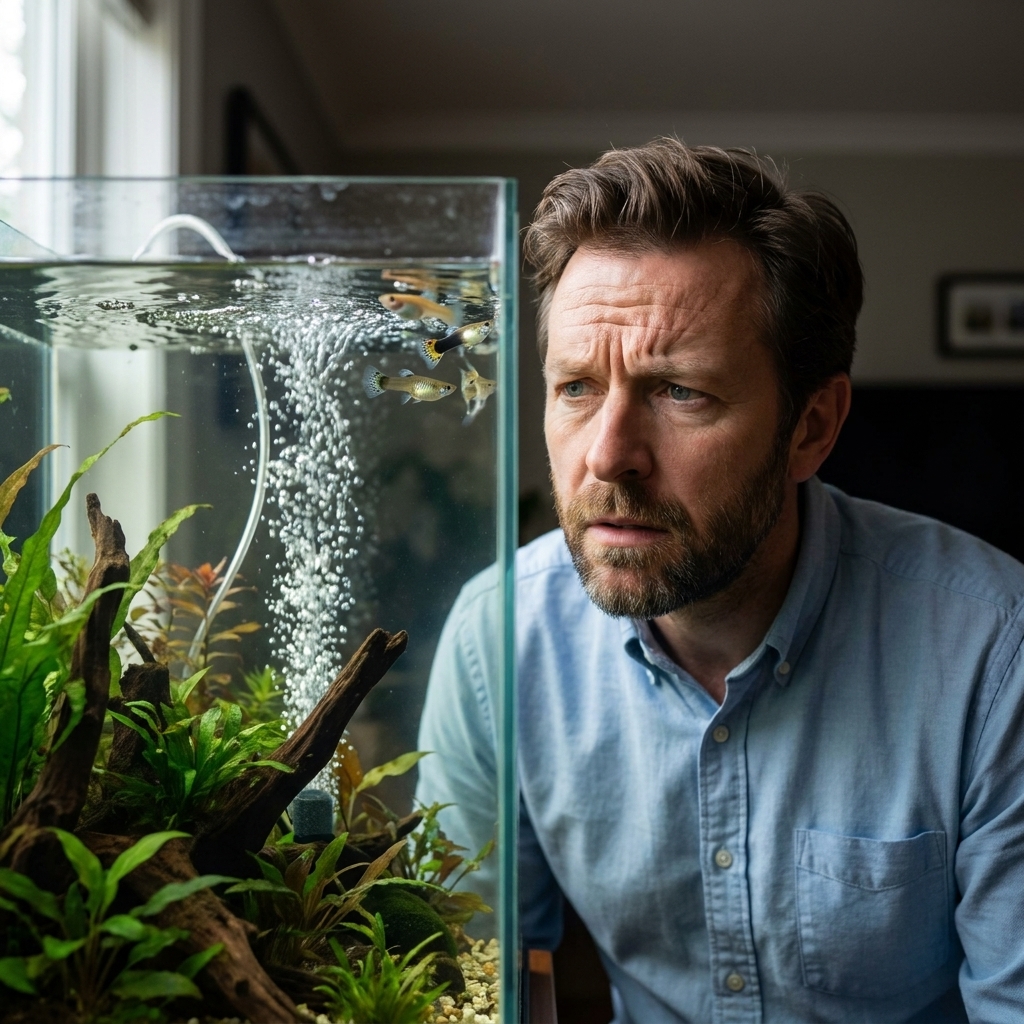
- Increase aeration. Add an airstone or increase surface ripple.
- Water changes as needed. If ammonia or nitrite shows up, do smaller changes (20 to 30%) daily or every other day to keep them at 0. If ammonia and nitrite are both zero, it is often best to let the bloom run its course while you cut back feeding.
- Add seeded media (from a healthy tank) if you have access, or use a reputable bottled bacteria to help stabilize.
These blooms often resolve in about a week, but they can take 1 to 2+ weeks if the tank is heavily stocked, overfed, or the biofilter is truly unstable.
Cause 2: fine dust
If you recently added sand or gravel, or you vacuumed aggressively and kicked up debris, the cloudiness can be tiny particles floating around.
What to do:
- Polish it out. Add filter floss or a fine polishing pad in your filter to trap particles. Replace it as it clogs.
- Do not keep stirring the substrate. Let the filter do the work.
- Rinse new mechanical media in dechlorinated water before installing so it does not add its own dust.
Cause 3: mineral precipitation
Sometimes water turns cloudy right after a major shift in water chemistry. A sudden change in GH or KH, switching water sources, or using strong buffers in hard water can cause minerals (often calcium carbonate) to precipitate and make the water look hazy.
What to do:
- Test KH and GH if possible, and avoid stacking multiple “buffer” products.
- Do a moderate water change using a consistent water source.
- Run fresh activated carbon for a week if the haze followed medication or additives. Carbon will not “fix” minerals, but it can remove many dissolved organics that add to haze and it can help clear some medication-related discoloration.
If you are chasing a specific pH number with chemicals, that is a common route to recurring cloudiness and stressed fish. Stability beats perfection almost every time.
Green water
Green water is not “dirt,” it is an explosion of free floating algae. The tank can look like pea soup even if your glass and decor are relatively clean.
Why it happens
- Too much light (long photoperiod, direct sun, very bright fixture)
- Excess nutrients (overfeeding, high nitrates, heavy fish load)
- Imbalance in planted tanks (light is high, but plants are not consuming nutrients efficiently)
Quick fixes
- Blackout for 3 days: Turn off aquarium lights and block ambient room light with a towel or blanket. Keep filtration and aeration running. Feed lightly or not at all.
- Oxygen check: During blackouts, watch fish for stress and keep surface agitation strong. If you run CO2, it is usually smart to pause or reduce it during the blackout and keep oxygen high.
- Reduce lighting after: Aim for 6 to 8 hours per day on a timer and keep the tank out of direct sunlight.
- Water changes: Do a 30 to 50% change after the blackout, then another 20 to 30% a few days later.
A blackout knocks green water back, but algae can rebound if the light and nutrient balance does not change afterward.
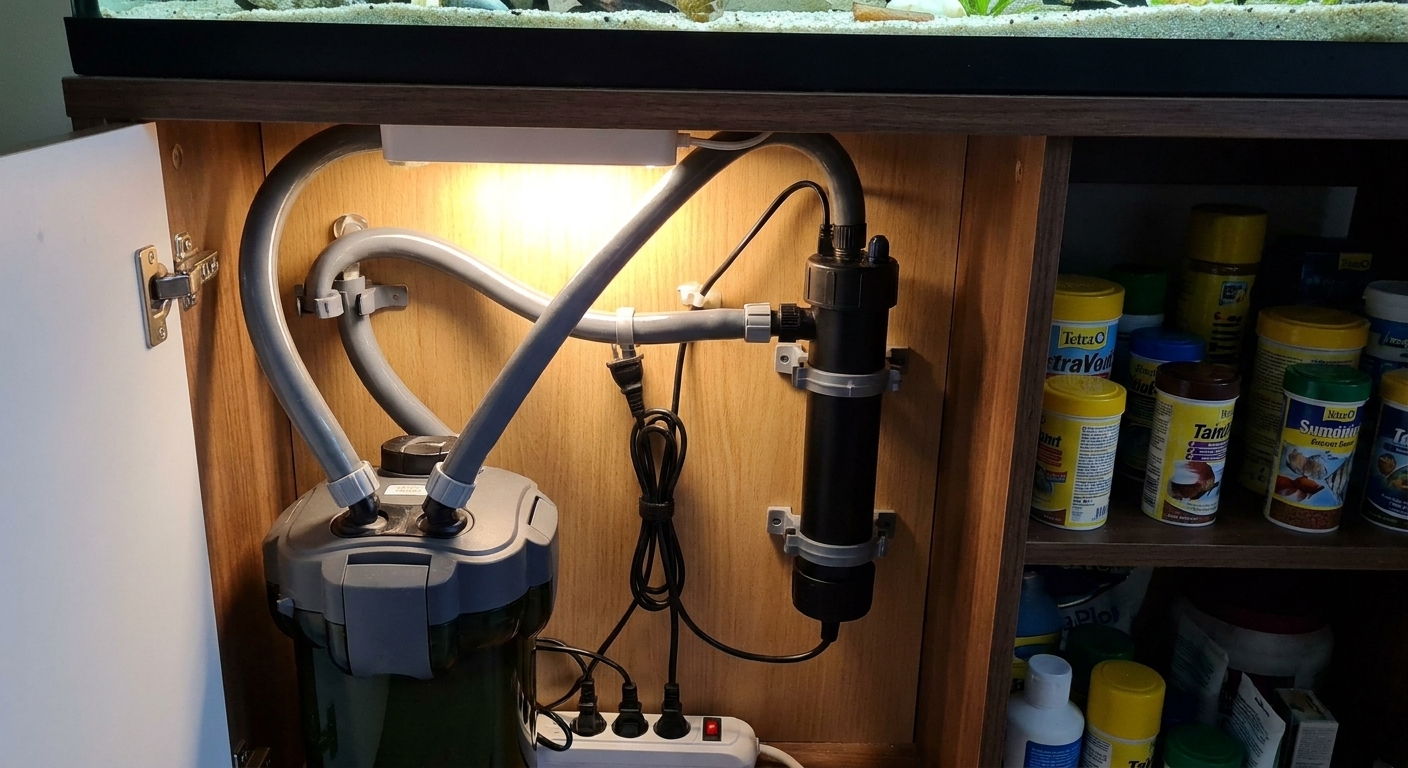
UV sterilizer
A properly sized UV sterilizer is the most reliable way to clear green water quickly. Many tanks clear in 24 to 72 hours, but results depend on UV wattage, flow rate (contact time), and how dense the bloom is.
UV is not a substitute for good husbandry. If you keep the same light and feeding habits, green water often returns once the UV is removed.
Brown or gray murk
Cause 1: detritus in suspension
If the water looks dirty after maintenance, it is often debris that got kicked up and is now too fine for your current mechanical filtration.
What to do:
- Upgrade mechanical filtration: Add filter floss, a finer sponge, or a polishing pad.
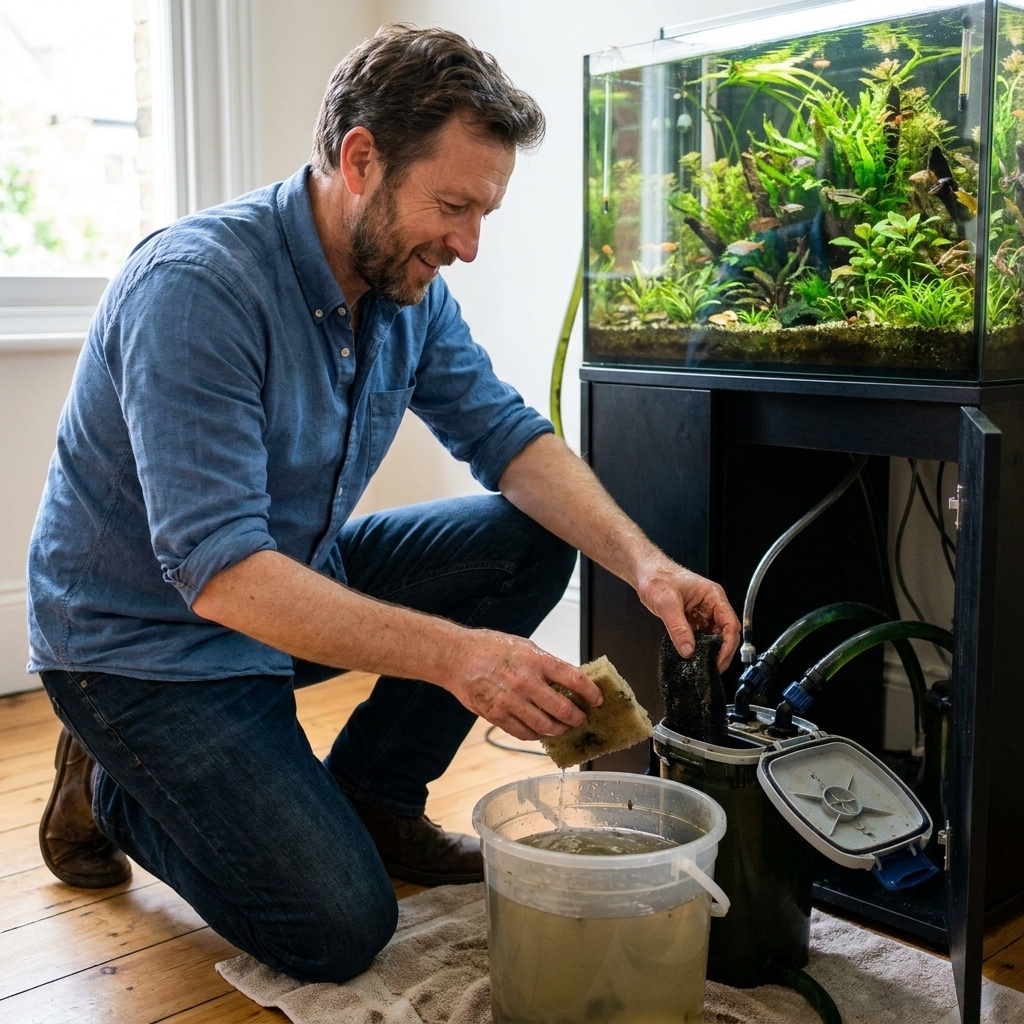
- Clean the filter correctly: Rinse sponges and media in a bucket of tank water, not under the tap.
- Gravel vac in sections: Do one third of the substrate per week rather than deep cleaning everything at once.
Cause 2: tannins
Tannins from driftwood or botanicals turn water tea-colored. This is not harmful and can be beneficial for many fish, but some keepers prefer clear water.
What to do if you want it clearer:
- Run activated carbon or a resin designed to remove tannins.
- Water changes over several weeks.
- Pre-soak driftwood before adding it to a display tank if you want to minimize initial tint.
Cause 3: filtration issues
If the tank is chronically hazy, look at flow rate and filter maintenance. A filter packed with debris can bypass water around media or simply not move enough water.
What to do:
- Restore flow: Clean the impeller, intake sponge, and tubing if you use a canister.
- Add prefiltration: An intake sponge catches gunk before it clogs the main media.
- Aim for appropriate turnover: As a rough guideline, many community tanks do well around 5 to 10 times tank volume per hour, but adjust for head height, filter type, plants, hardscape, and fish that hate strong current (like bettas and some gouramis).
What not to do
- Do not replace all filter media at once. That is where much of your beneficial bacteria live.
- Do not keep adding “clarifier” repeatedly. Clarifiers can clump particles so the filter catches them, but overdosing or using them in the wrong scenario can stress fish and gum up filters.
- Do not overfeed “to help fish through stress.” Extra food becomes extra waste, which is exactly what cloudy tanks do not need.
- Do not chase pH with chemicals. Stability is safer than bouncing parameters.
My plan for clear water
If you are not sure what you are dealing with, this sequence solves most cases without harming fish.
Day 1
- Test ammonia and nitrite.
- If either is above 0 ppm: do a 30 to 50% water change, add dechlorinator, increase aeration, and feed very lightly.
- Add fine mechanical filtration (filter floss or a polishing pad) to capture suspended particles. Expect to replace it as it loads up.
- Check for hidden waste: a dead fish, rotting plant clump, or forgotten food can keep a tank cloudy no matter what else you do.
Days 2 to 4
- Retest daily if the tank is new, you recently added fish, or readings were elevated.
- Do 20 to 30% water changes as needed to keep ammonia and nitrite at 0.
- Keep lights to 6 to 8 hours. If the water is green, consider a 3-day blackout and keep oxygen high.
- Avoid major cleanings back to back. Let the filter bacteria recover and stabilize.
Days 5 to 10
- Replace clogged floss or pads with fresh material as needed.
- Resume normal feeding slowly, watching for cloudiness returning.
- Set a sustainable routine: consistent water changes, reasonable stocking, and a timer for lights.
FAQ
Is cloudy water normal after a water change?
A little haze can be normal, especially if you disturbed the substrate or your tap water is high in minerals. It should clear within 24 to 48 hours. If it gets worse overnight, think bacterial bloom or a cycle issue and test ammonia and nitrite.
Can cloudy water kill fish?
The cloudiness itself is usually not what harms fish. The danger is what it represents, most commonly ammonia or nitrite, low oxygen during a bacterial bloom, or decaying waste. Test first, then act.
Should I use a water clarifier?
Clarifiers can help when the problem is suspended particles and your filter can remove the clumps. They will not fix green water algae and they will not fix an uncycled tank. If you use one, use it once, follow dosing exactly, and watch your filter closely.
Why is my aquarium cloudy even though my tests are fine?
Often it is mechanical, not chemical: fine dust, mulm in suspension, tannins, or inadequate filtration. Add fine mechanical media, restore flow, and avoid stirring the substrate repeatedly.
Why did my tank get cloudy after adding new fish?
Two common causes are a mini-cycle (the biofilter is not yet sized for the new bioload) and overfeeding. Test ammonia and nitrite for several days after new additions, feed lightly, and avoid cleaning the filter aggressively during that period.
What if the cloudiness started after medication?
Some medications can tint water or trigger a bloom by stressing the biofilter. After treatment is complete and your fish are stable, fresh activated carbon and a few moderate water changes can help clear lingering discoloration. Do not run carbon during treatment unless the medication instructions say it is safe.
Keep it clear
Crystal clear water is not about constant intervention. It is about steady inputs and a filter that can keep up.
- Feed less than you think. Most fish will thrive on smaller portions.
- Use a light timer. Consistency prevents algae and keeps plants stable.
- Do regular water changes. Even 20 to 30% weekly makes a huge difference for clarity and fish health.
- Clean filters gently and in rotation. Preserve beneficial bacteria by rinsing media in tank water.
- Quarantine new fish when possible. Sick fish and heavy medications can destabilize filtration and water clarity.
If you tell me what color the cloudiness is, how old the tank is, and your ammonia and nitrite readings, I can usually narrow it down to one or two likely causes quickly. That is the secret most generic advice skips: clear water comes from diagnosis, not random products.